K2
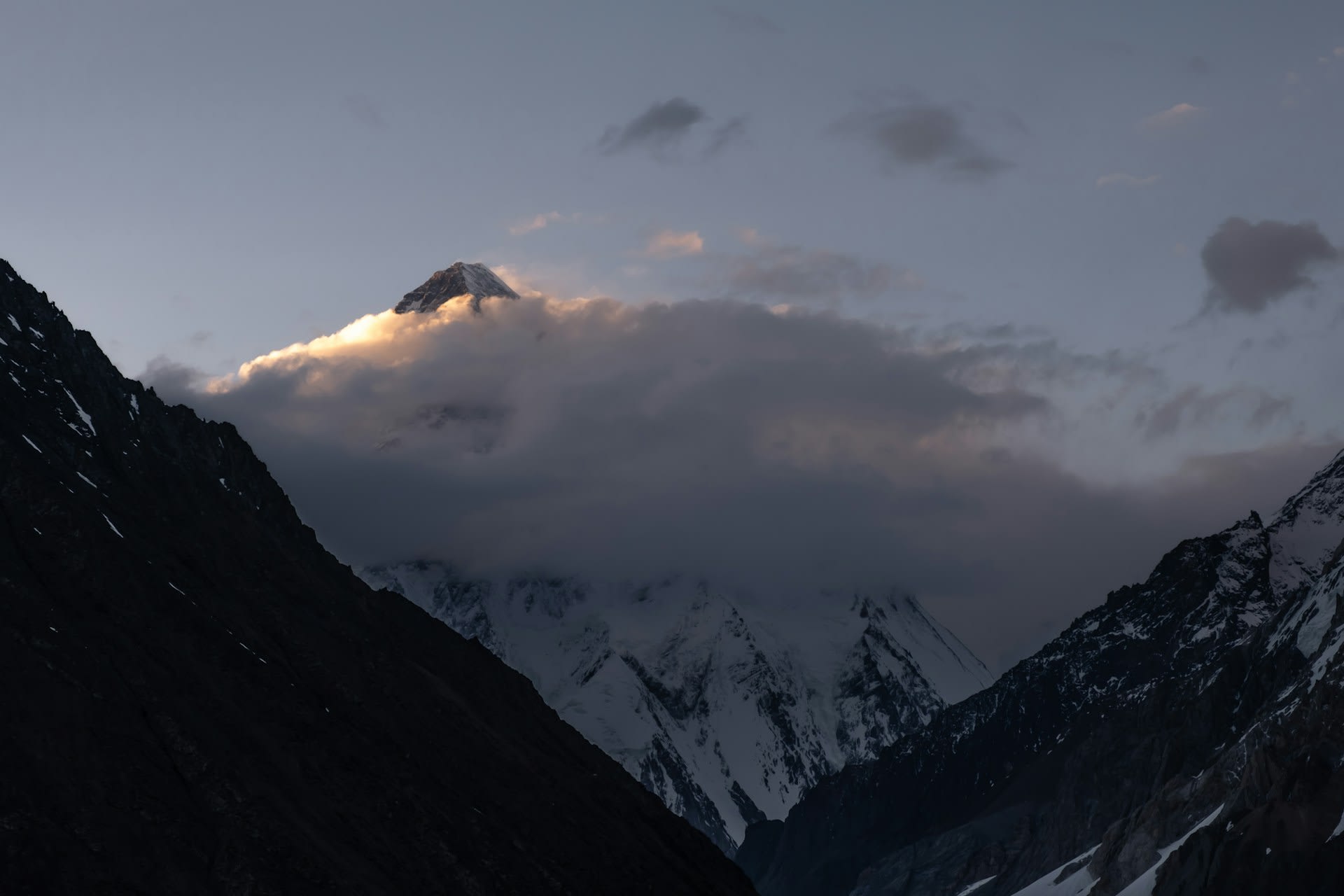
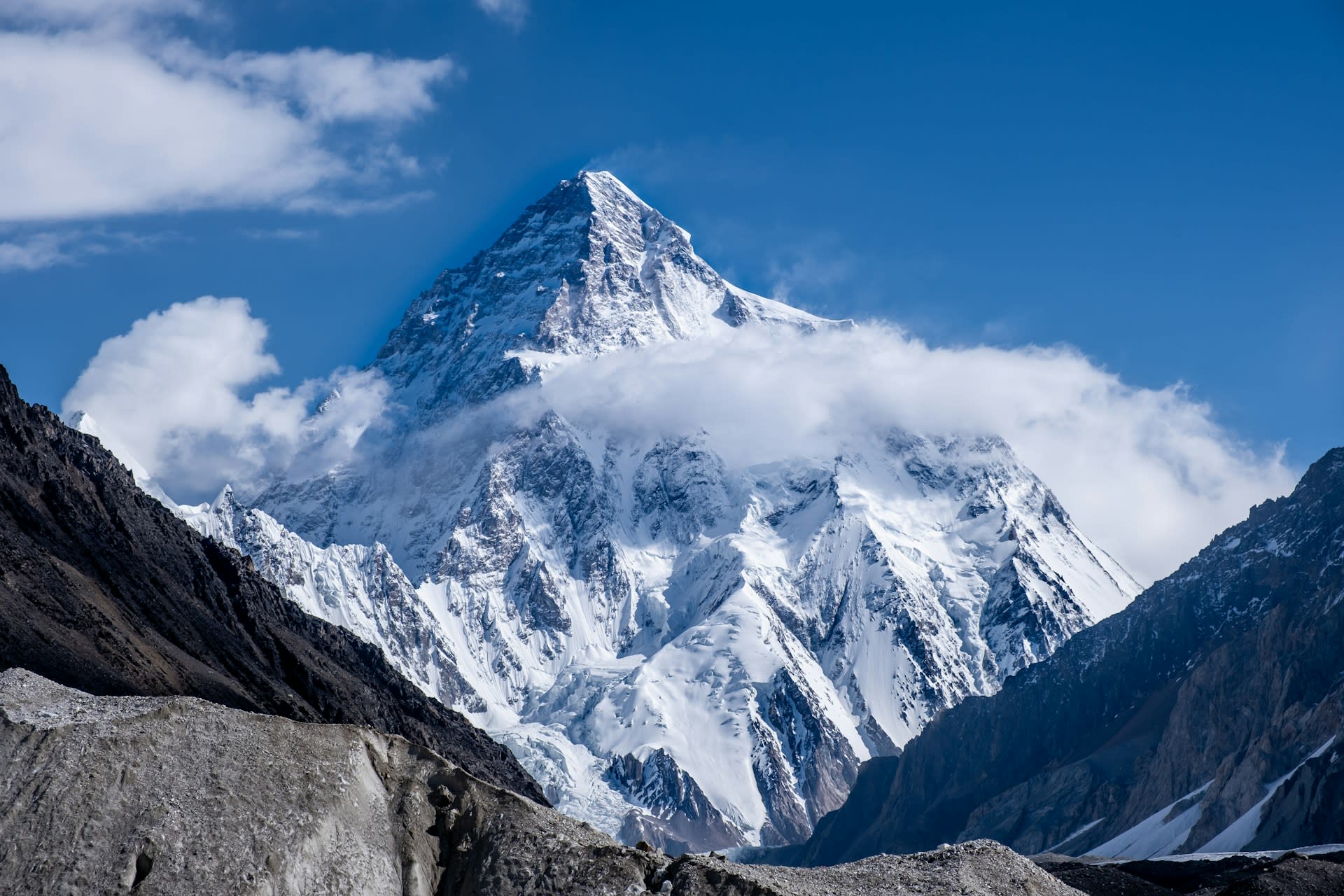
K2, standing at 8,611 metres on the border of Pakistan and China, is the second-highest mountain on Earth and by virtually every measure the most dangerous. Known as the 'Savage Mountain' or the 'Mountaineer's Mountain,' it has a summit success rate far lower than Everest and a death-to-summit ratio that stands at approximately one death for every four successful ascents. For trekkers, the journey to K2 Base Camp through the Baltoro Glacier — passing the extraordinary 'Throne Room of the Mountain Gods' — is one of the world's great wilderness expeditions regardless of summit ambition.
🌍 Geography and Ecosystem
K2 rises from the central Karakoram range, the world's most densely glaciated area outside the polar regions:
- Baltoro Glacier: One of the world's longest glaciers at 63 km, the Baltoro serves as the highway to K2 Base Camp, passing the dramatic Concordia junction — where four massive glaciers meet beneath a circle of 8,000 m peaks.
- Karakoram Concentration: Within a 30 km radius of K2 stand four other 8,000 m peaks — Broad Peak, Gasherbrum I, Gasherbrum II, and Masherbrum — creating the highest concentration of extreme altitude in the world.
- The Bottleneck: K2's most infamous feature — a narrow couloir at 8,200 m beneath a hanging serac — has been the site of the mountain's most catastrophic accidents, including the loss of eleven climbers in a single day in August 2008.
- Flora and Fauna: The lower Braldu and Shigar valleys approaching the Karakoram have birch and juniper forests supporting snow leopards, ibex, and Marco Polo sheep.
📜 History and Cultural Significance
K2 was first surveyed by the Great Trigonometrical Survey of India in 1856, receiving its surveying designation K2 (second peak of the Karakoram) because it had no local name visible from the survey station — unlike most Himalayan peaks, K2 is invisible from habitation and was unknown to the nearest villages. The first serious expedition was led by Oscar Eckenstein and Aleister Crowley in 1902. K2 was finally summited on 31 July 1954 by Achille Compagnoni and Lino Lacedelli of the Italian expedition — one of the most controversial ascents in mountaineering history due to events surrounding the high-altitude porter Walter Bonatti. Winter ascents remained the last great challenge in Himalayan mountaineering; K2 was not climbed in winter until January 2021, by a team of Nepalese climbers.
🏃 Activities and Attractions
K2 offers two main visitor experiences — the iconic base camp trek and serious mountaineering expeditions:
- K2 Base Camp Trek: The classic 12–16 day return trek from Askole village follows the Braldu River and Baltoro Glacier through some of the most spectacular mountain scenery on Earth. No technical climbing is required but fitness and acclimatisation are essential.
- Gondogoro La Crossing: A high-altitude (5,585 m) crossing that connects the Baltoro with the Hushe Valley, offering dramatic views of K2 and the other giants from above.
- Concordia: The 'Throne Room of the Mountain Gods' — the junction of the Baltoro and Godwin-Austen glaciers, ringed by five 8,000 m peaks — is often cited as the most magnificent mountain panorama on Earth.
- Mountaineering Expeditions: Permitted by the Pakistan Alpine Club, K2 expeditions require extensive preparation, permits, and experienced guides.
💡 Travel Tips
How to Get There: Fly from Islamabad to Skardu (1 hour, subject to weather) then drive to Askole (8–10 hours) — the last village before the glacier. The trek typically begins from Askole. Coordinates: 35.88° N, 76.51° E.
Best Time to Visit: June–August for the standard trekking window. July is generally most stable. Expect snow and sub-zero temperatures at base camp (5,150 m) at all times.
What to Bring: Full 4-season camping equipment, warm sleeping bag rated to -20°C, trekking poles, high-altitude boots, and extensive sun protection. A licensed local guide and a registered agency are strongly recommended and in some areas required.
Permits: Trekking permits are required and can be arranged through registered Pakistani trekking agencies in Islamabad or Skardu.
Best Time to Visit: June–August for the standard trekking window. July is generally most stable. Expect snow and sub-zero temperatures at base camp (5,150 m) at all times.
What to Bring: Full 4-season camping equipment, warm sleeping bag rated to -20°C, trekking poles, high-altitude boots, and extensive sun protection. A licensed local guide and a registered agency are strongly recommended and in some areas required.
Permits: Trekking permits are required and can be arranged through registered Pakistani trekking agencies in Islamabad or Skardu.
🌱 Conservation
The Karakoram's fragile high-altitude ecosystems face pressure from the rapidly growing number of trekking expeditions. Waste management on the Baltoro Glacier has improved significantly since the Pakistan Army began coordinated clean-up operations, but human waste, expedition refuse, and fuel drums remain concerns at high camps. Porters — the backbone of every K2 expedition — have historically faced inadequate equipment, pay, and safety standards; improved porter welfare guidelines from the Pakistan Alpine Club have brought some progress. Climate change is accelerating glacial retreat along the Baltoro at measurable rates, altering the landscape that future generations of trekkers will encounter.
✨ Conclusion
K2 is mountaineering's ultimate challenge and one of the world's most powerful natural monuments. Even for those who will never rope up for its flanks, the journey to base camp delivers a profound encounter with a landscape of unparalleled scale and drama. The Baltoro Glacier trek is not the easiest or most accessible adventure in Pakistan, but it is arguably the greatest.