Deadvlei
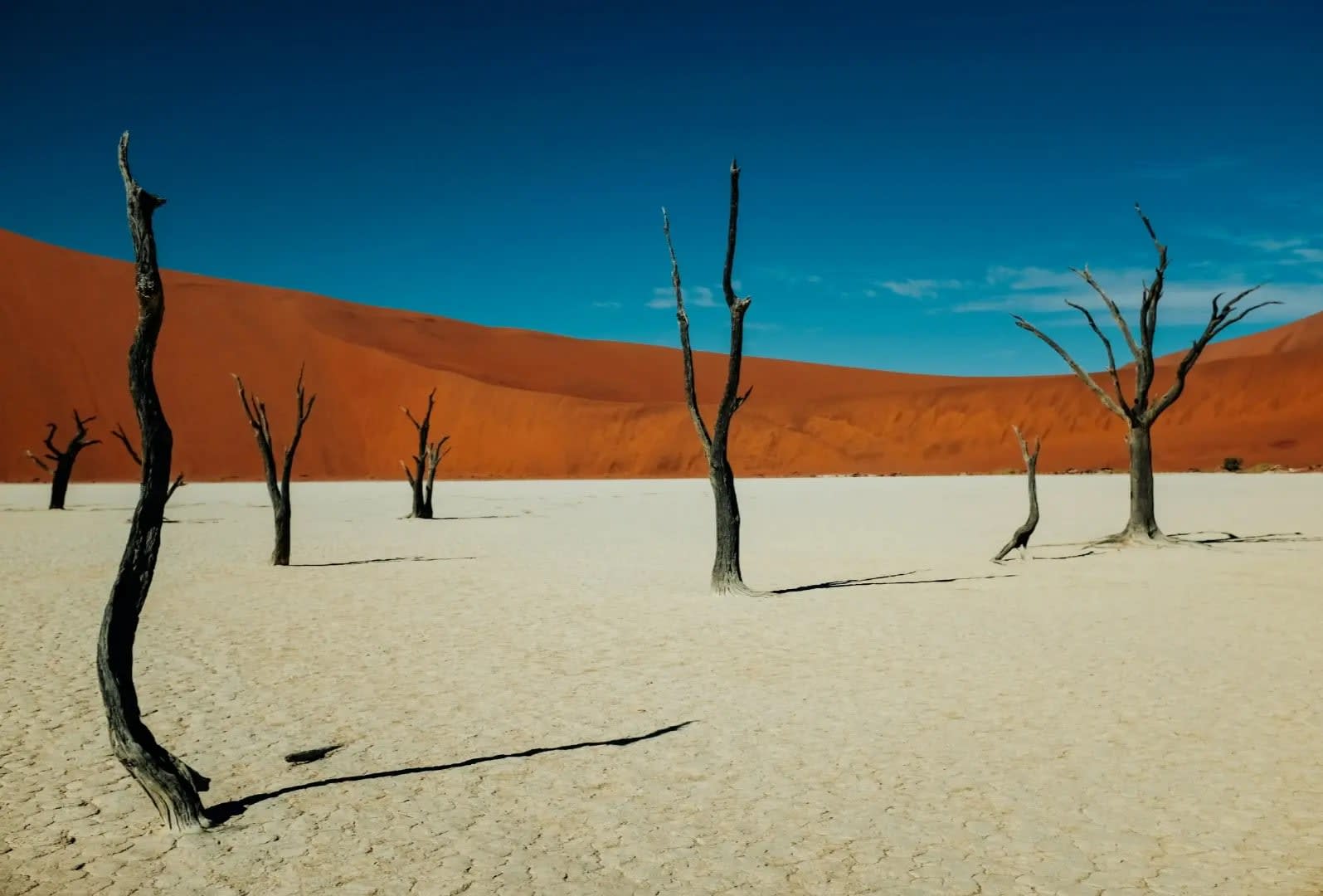
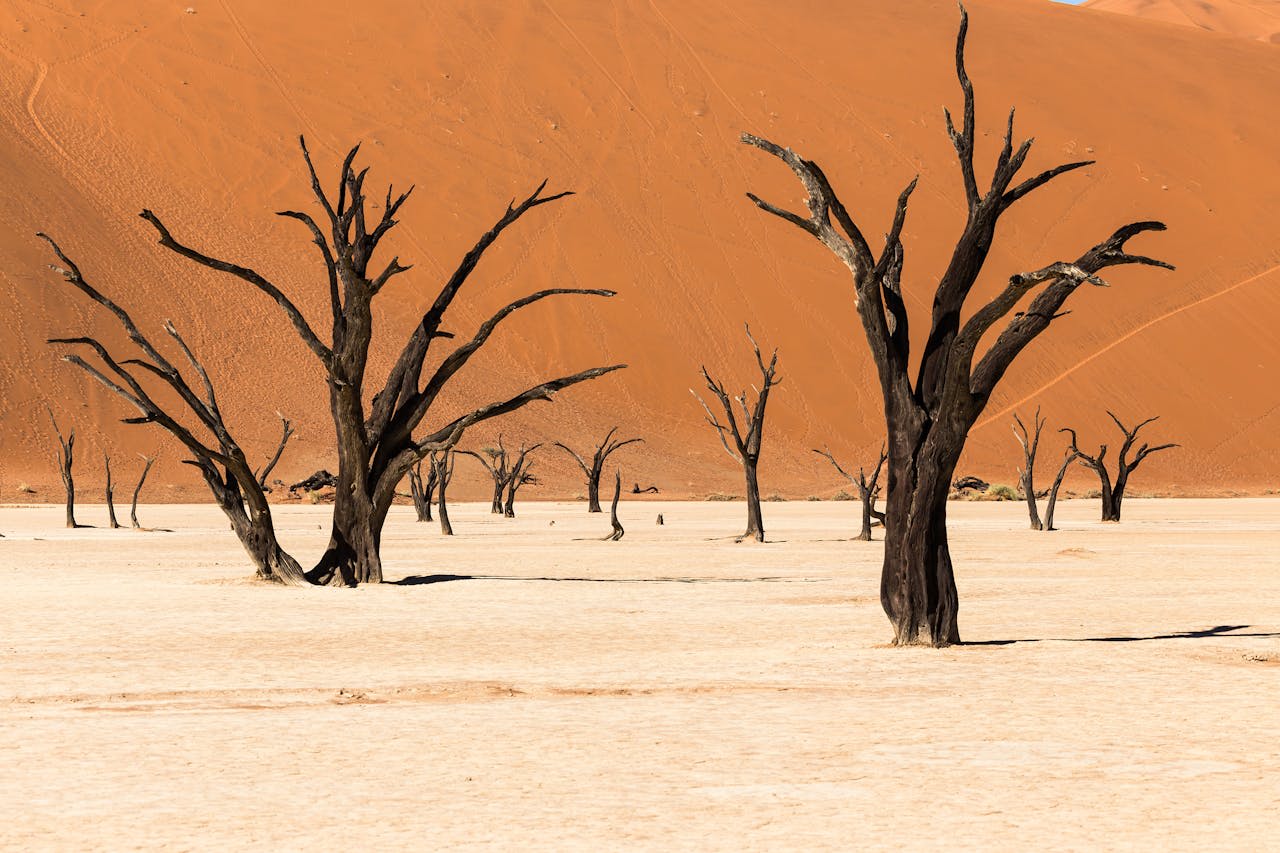
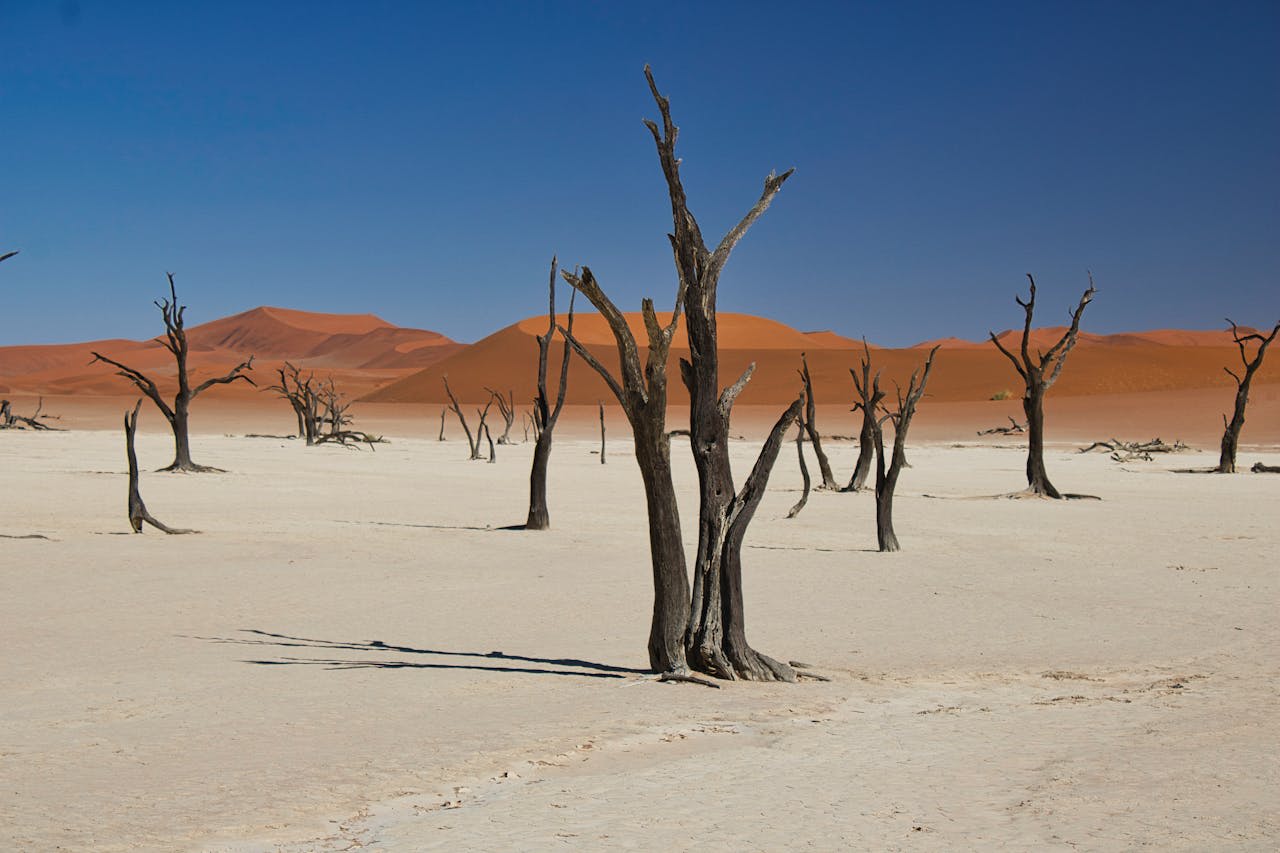
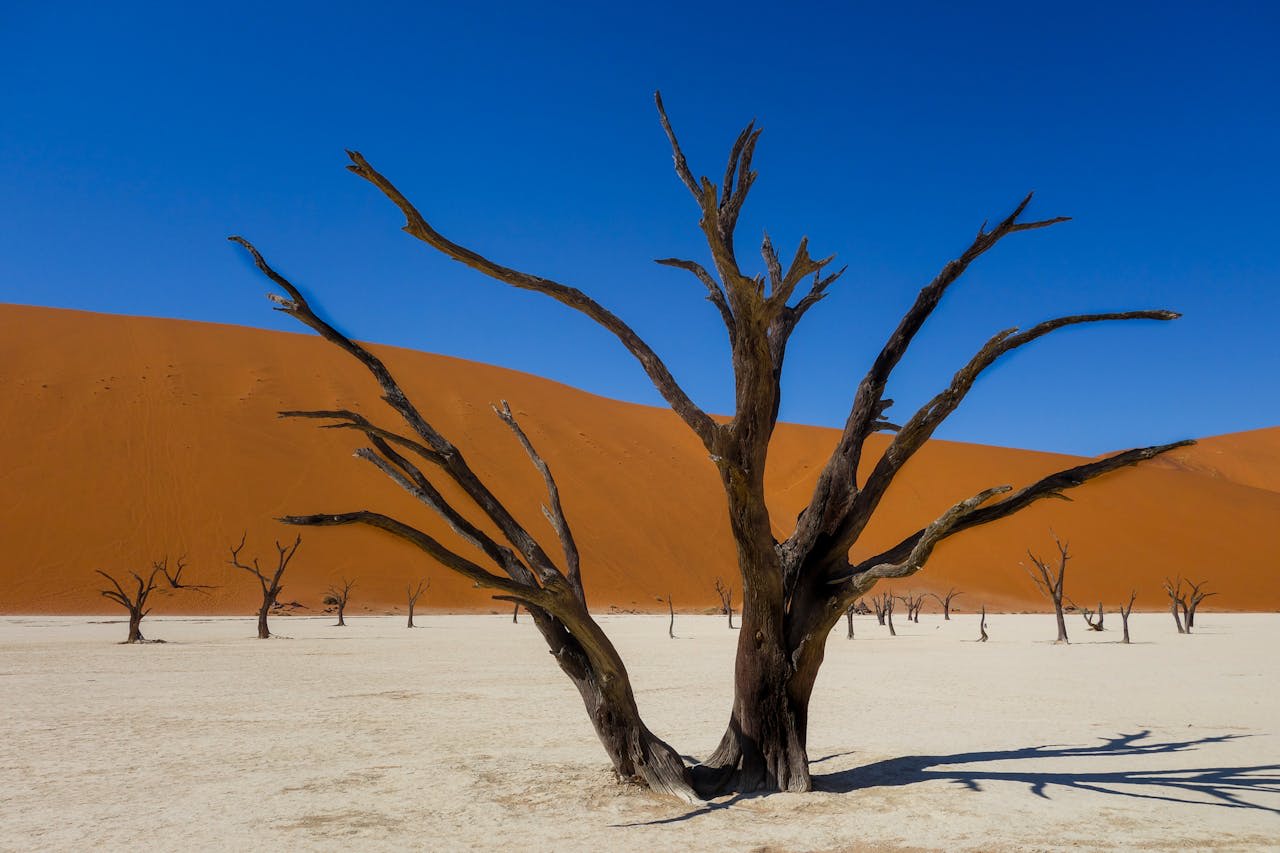
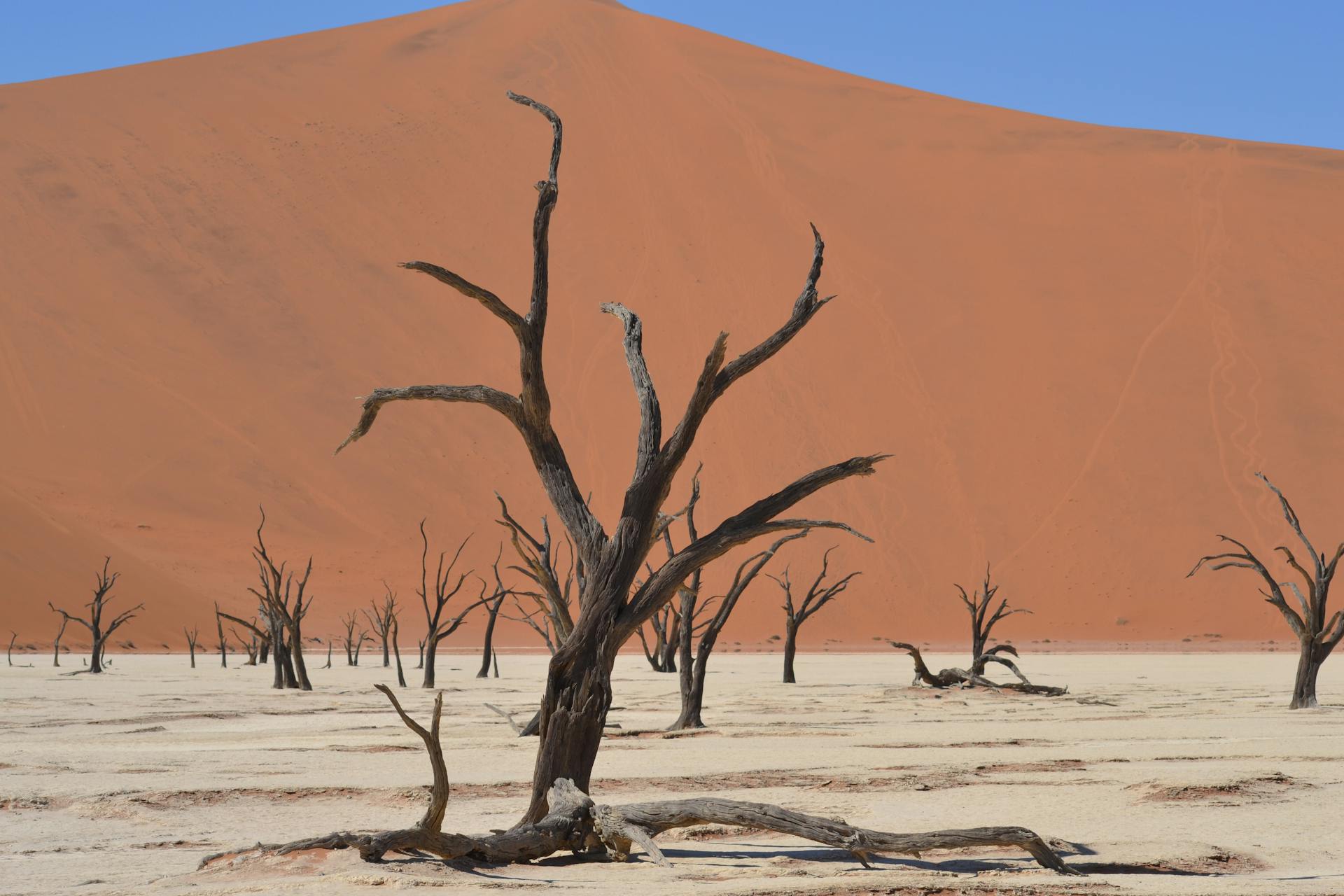
Deadvlei (dood vlei — 'dead marsh' in Afrikaans) is a white clay pan approximately 500 metres long and 250 metres wide, enclosed within the towering red-orange sand dunes of the Sossusvlei area of Namib-Naukluft National Park in central Namibia. The pan is carpeted with a brilliant white surface of dried calcium carbonate clay, cracked into polygonal plates by the extreme aridity, and populated with the blackened skeletal forms of approximately 900 dead camel thorn trees (Vachellia erioloba) — trees that died when the Tsauchab River was cut off by advancing dunes approximately 900 years ago and the pan dried completely. The dead trees did not decompose because the desert air is too dry for fungal breakdown; they are preserved as carbon-black husks standing in perfect geometric contrast to the white pan and the burnt-orange dune walls that enclose the space. The visual result — black trees, white clay, orange sand, blue sky — is one of the most reproduced landscape photographs in the world, and one of the very few places on Earth where the landscape looks more extraordinary in person than in any image.
🌍 Geography and Ecosystem
- Big Daddy and Big Mama Dunes: The two highest dunes flanking Deadvlei — Big Daddy (325 m above the pan floor) and Big Mama (250 m) — are the primary climbing challenges for visitors. Big Daddy's climb takes 45–60 minutes in deep sand and rewards with a panoramic view of Deadvlei from directly above. The descent into the pan can be made directly down the slip face — a sliding descent of fine sand. The colour change from the deep red of the climb to the white of the pan floor below is visually dramatic.
- Sossusvlei Pan: The main vlei (pan) 5 km from Deadvlei floods occasionally — roughly every decade — when exceptional rainfall fills the Tsauchab River sufficiently to push water past the dunes into the pan. During flooding years (most recently 2011 and 2021), Sossusvlei transforms briefly into a lake of dark water reflecting the orange dunes, attracting flamingoes and wading birds. These events are temporary and unpredictable; in normal years the pan is completely dry.
- Dune 45: A photogenic star dune 45 km along the road from the park gate, accessible before sunrise for the most visited sunrise viewpoint in the Namib. The dune's name derives simply from its position marker. Its accessible ridge, accessible in 20–30 minutes of climbing, offers the classic Namib dune silhouette view against the pre-dawn sky. The dune surface changes colour continuously from rose pink at dawn through orange to deep red in midday sun.
- Sesriem Canyon: A 30-metre deep gorge cut by the Tsauchab River through the surrounding sandstone and conglomerate, located near the park entrance at Sesriem — the only permanent surface water in the immediate area and therefore a wildlife gathering point. The canyon provides shade and a visual contrast to the open dune landscape and can be walked through in approximately one hour.
📜 History and Cultural Significance
The Sossusvlei area became part of a government reserve in 1907 and was incorporated into the Namib-Naukluft National Park — now the largest game reserve in Africa at 49,768 km² — in 1979. Tourism to Sossusvlei and Deadvlei developed rapidly from the 1990s, and the area is now Namibia's most visited natural attraction, receiving over 200,000 visitors annually. The park gate at Sesriem opens at sunrise to allow visitors to reach the pans before the extreme midday heat; photography at Deadvlei in the hour after sunrise, when the low-angle light turns the dunes incandescent orange against the blue sky, has made this one of the most documented sunrise locations in the world.
🏃 Activities and Attractions
- Sunrise at Deadvlei: The defining Sossusvlei experience — entering the park gate the moment it opens at sunrise, driving or taking the shuttle 65 km to the 4WD-only section, crossing the remaining 5 km on foot through soft sand to Deadvlei, and photographing the dead trees as the first direct light strikes the dune wall and illuminates the pan. The window of optimal light is approximately 45 minutes before the harsh midday shadows destroy the contrast. A tripod is essential for long exposures in the pre-dawn blue light.
- Climbing Big Daddy: The 45–60 minute climb up Big Daddy's shifting sand face to the 325 m summit is physically demanding but technically straightforward. The summit view — looking down into the white Deadvlei pan with the black trees reduced to matchsticks, and the surrounding dune sea extending to every horizon — is one of the most extraordinary high viewpoints in Africa. Descent via the slip face takes 5 minutes. Attempt the climb before 08:00 — the sand surface exceeds 60°C by mid-morning.
- Hot Air Balloon Over the Dunes: Dawn balloon flights over the Sossusvlei dune field — departing from camps outside the park in the predawn dark and floating over the dune crests at sunrise — provide an aerial perspective of the landscape that no ground-based observation can match. The shadow patterns of the dunes in low-angle light seen from above are among the most beautiful natural forms in the world. Flights typically land in the desert for a champagne breakfast as the sun rises over the horizon.
- Sesriem Canyon Walk: The 1.5 km walk through Sesriem Canyon provides a shaded geological exploration of the Namib's sedimentary history — the canyon walls expose 15–20 million years of alluvial deposit from ancient Tsauchab River floods, with rounded river cobbles embedded in conglomerate layers at height demonstrating the previous scale of the river system. The deepest section of the canyon holds a pool of permanent water that sustains small wildlife populations including klipspringer and rock hyrax.
- Night Sky Observation: The Namib Desert has some of the darkest skies in the southern hemisphere — remote from any significant light pollution and at sufficient altitude (900–1,000 m) for atmospheric clarity. The Milky Way core (the galactic centre) is directly overhead in July–September, and the southern hemisphere's advantage of the Magellanic Clouds — two satellite galaxies of the Milky Way visible to the naked eye — makes Sossusvlei one of the world's outstanding astronomical observation sites. Several lodges offer guided night sky sessions with telescopes.
💡 Travel Tips
Best Season: May–September (austral winter) for cool temperatures (8–25°C) and the clearest skies. October–April is hot to extremely hot (35–45°C midday) — sunrise visits are manageable but the heat becomes brutal by 09:00. The rainy season (January–April) occasionally fills Sossusvlei itself, creating rare and spectacular flooding events, but road access can be disrupted. June–August is peak season; lodges should be booked months in advance.
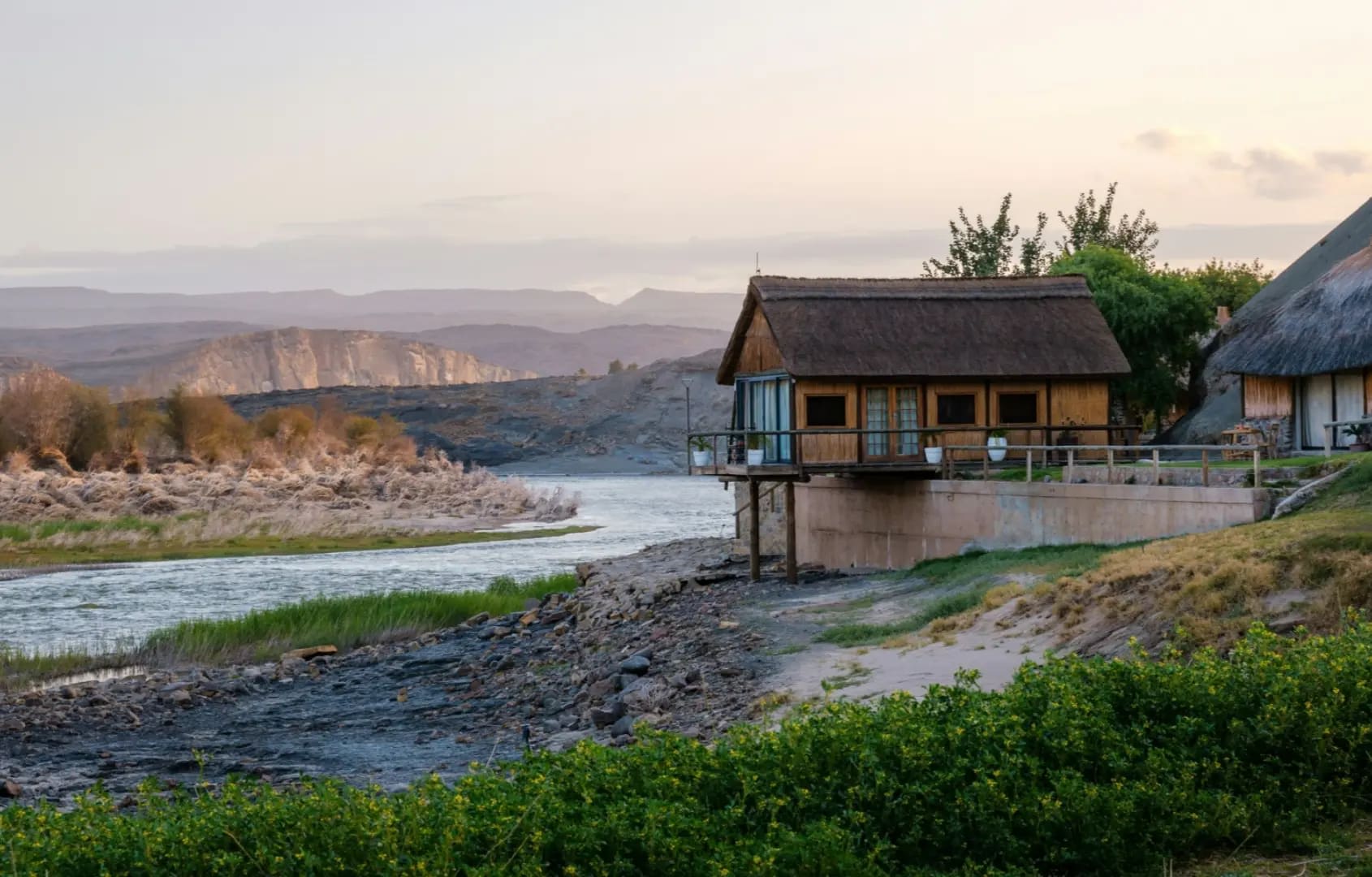
Accommodation: Several lodges cluster outside the park gate at Sesriem (inside the park, accommodation is at the Sesriem campsite only). Best-regarded are Sossusvlei Desert Lodge (inside the park — most exclusive), Little Kulala, and Hoodia Desert Lodge. Budget travellers use Sesriem campsite — the only accommodation inside the park — which has electricity, hot showers, and a pool. Book well ahead for any Sossusvlei accommodation during June–September.
🌱 Conservation
The primary conservation concern in the Sossusvlei area is climate change: the Tsauchab River's flood frequency — already rare — may decrease further under projected drying trends for southern Africa, reducing the episodic flooding that refreshes the pans and the biological events that depend on it. The Welwitschia mirabilis — a remarkable gymnosperm plant that grows only in the Namib and can live for 1,500–2,000 years — faces increasing moisture stress as the coastal fog that provides its primary water source becomes less frequent and penetrates less far inland. The Namib's extreme antiquity makes it a reference system for understanding desert ecology under climate change.