
Wadi Rum
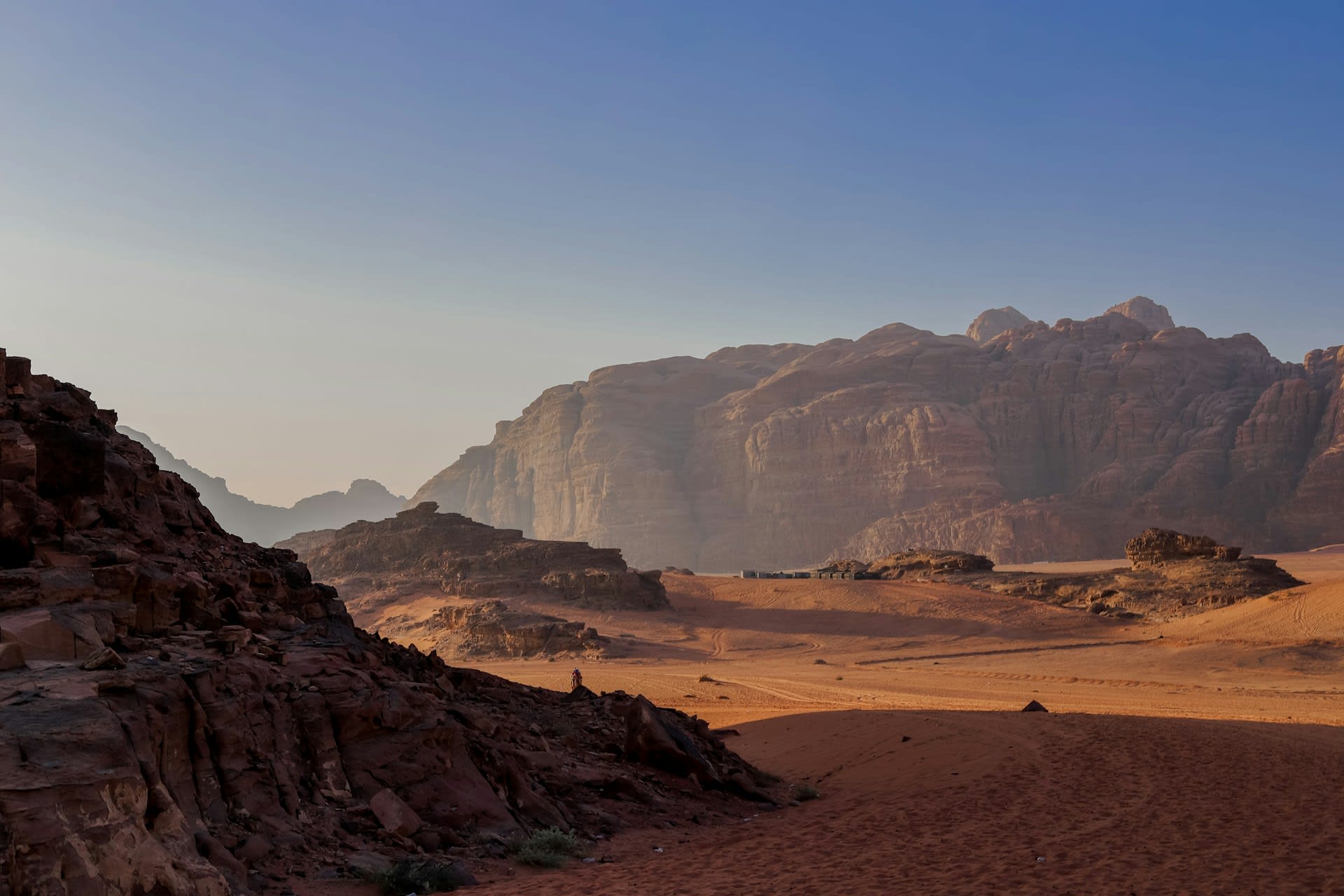
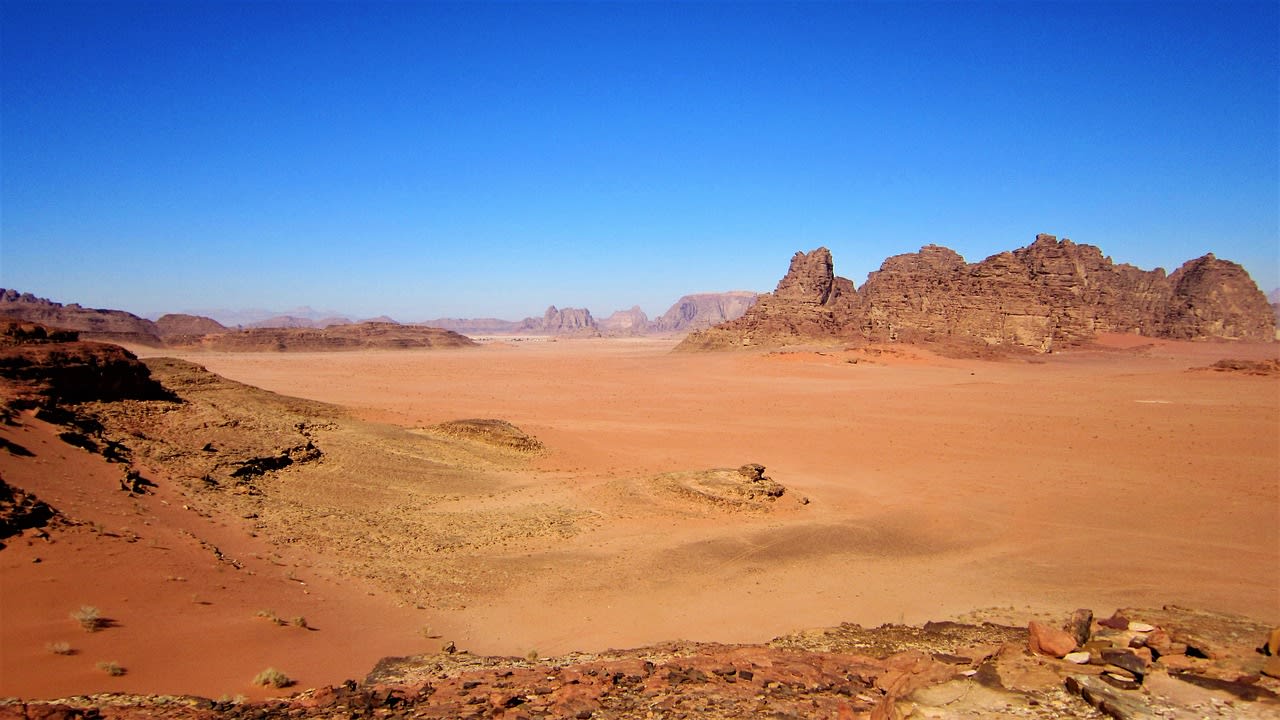
Wadi Rum (Arabic: وادي رم, also known as the Valley of the Moon) is a protected desert wilderness of 74,180 hectares in the far south of Jordan, inscribed as a UNESCO World Heritage Site in 2011 for its outstanding combination of geological and archaeological significance and its exceptional natural beauty. The landscape is defined by enormous pillars and cliffs of ancient Precambrian granite and Cambrian sandstone — some rising 600–800 metres from the flat sandy valley floors — eroded over millions of years into a maze of narrow gorges (siqs), natural arches, and monumental free-standing rock towers that turn from salmon-pink to deep crimson under the setting sun. The valley floor is a mosaic of red and gold sand, compacted gravel plains, and rock outcrops threaded with Bedouin camel tracks. The protected area is home to approximately 3,000 Zalabia Bedouin who have managed the land for centuries and operate virtually all tourism services within the desert — a model of indigenous-led heritage management that the UNESCO designation formally recognised.
🌍 Geography and Ecosystem
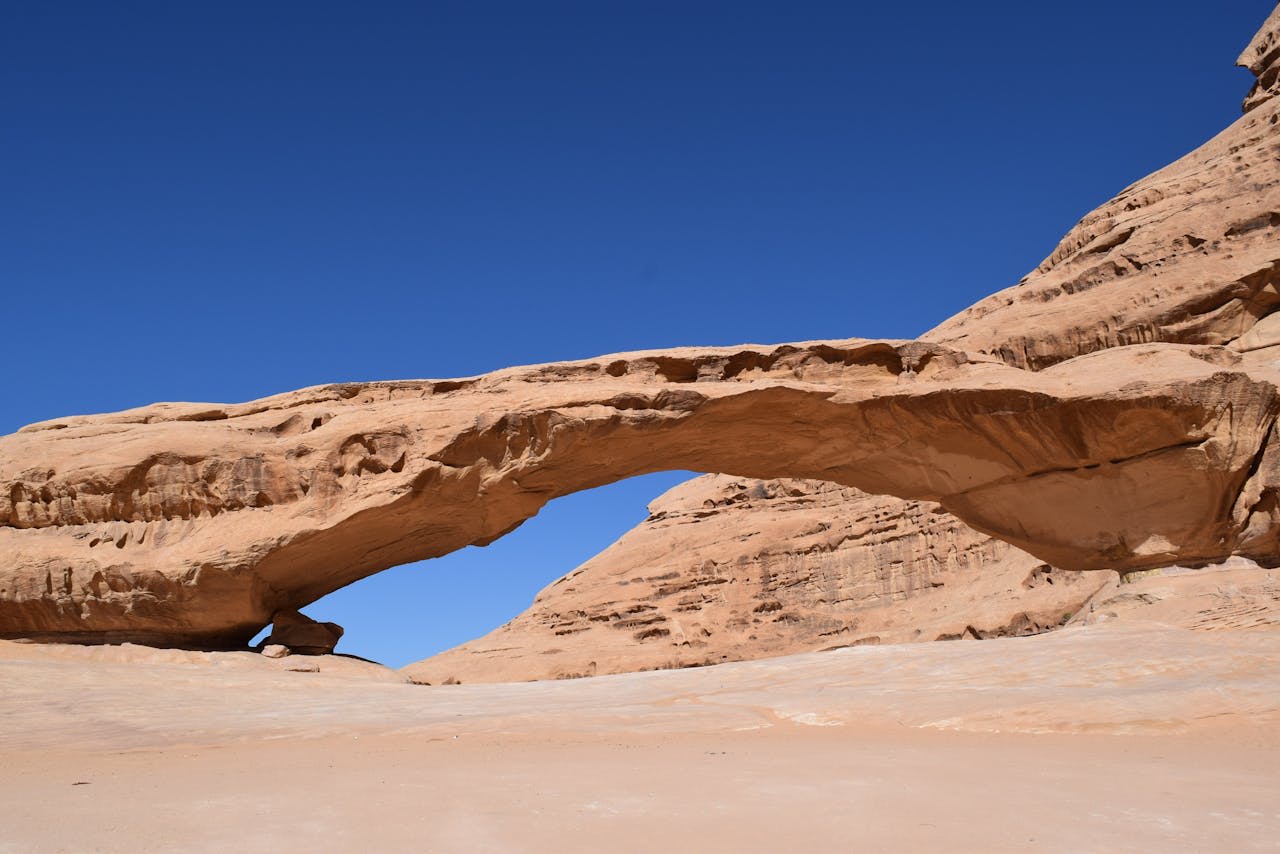
- Burdah Rock Bridge: One of the world's most remarkable natural arches — a free-standing sandstone bridge at 1,700 metres altitude, 35 metres wide and 80 metres above the ground, accessible by a demanding 2-hour rock scramble requiring some exposure to heights. The views from the arch across the Rum plains and into Saudi Arabia are among the finest in the Middle East.
- Khazali Canyon (Siq): A narrow gorge penetrating 150 metres into a sandstone massif, whose shaded walls carry one of Wadi Rum's richest collections of rock art and inscriptions — Nabataean, Thamudic, and pre-Nabataean scripts alongside human figures, camels, ibex, and hunting scenes spanning at least 4,000 years. The canyon stays cool even in summer due to its narrow dimensions and can be entered without a guide.
- Jebel Khazali and Lawrence's Spring: A freshwater spring on the cliff face of Jebel Khazali, identified in T.E. Lawrence's account as a water source used by the Arab Revolt forces. The spring emerges through a crack in the sandstone cliff and supports a small area of vegetation in an otherwise arid environment. A short rock scramble leads to a naturally formed stone shelf where Lawrence describes resting on his campaign.
- Red Sand Dunes of Wadi Rum: The southern portion of the valley contains the highest sand dunes in Jordan — red-orange sand ridges up to 30 metres high, composed of iron-oxide-rich quartz grains. The dunes are accessible on foot or by camel and are particularly photogenic in morning and evening light when long shadows emphasise the ripple patterns. Sandboarding is available from several Bedouin camps at the dune base.
📜 History and Cultural Significance
Wadi Rum is inextricably associated with T.E. Lawrence ('Lawrence of Arabia'), the British officer who coordinated the Arab Revolt (1916–18) against Ottoman rule from a headquarters at Aqaba. Lawrence spent considerable time in Wadi Rum during the campaign and described it in his celebrated memoir Seven Pillars of Wisdom (1926) in some of the finest nature writing in the English language: 'We looked up on the left to a long wall of rock, shining and slipping as if alive...the crags were capped in nests of domes, less austere than the frowning front of the cliffs, but with a pale beauty of their own.' The film Lawrence of Arabia (1962, David Lean) used Wadi Rum as a primary location and introduced the landscape to a global cinema audience. In recent years, Wadi Rum's extraordinary geological scenery has made it the preferred filming location for science fiction productions including The Martian (2015), Rogue One: A Star Wars Story (2016), and Dune: Part One (2021).
🏃 Activities and Attractions
- Jeep Tours: The primary mode of visiting the major desert features — open-sided 4WD pickup trucks driven by Bedouin guides traverse the flat valley floors between the principal rock formations, stopping at natural arches, inscriptions, sand dunes, and Lawrence's Spring. Half-day (4-hour) and full-day tours are the standard products, with routes customisable by interest. Sunset jeep tours timed to the light on the red sandstone are the most photogenic option.
- Camel Trekking: Multi-hour and multi-day camel treks follow traditional Bedouin routes through terrain inaccessible to vehicles. Overnight desert camps after a day's camel trekking provide the most authentic immersion in the landscape — particularly at night, when the lack of light pollution makes the Milky Way extraordinarily vivid. Camel treks range from 2-hour introductory rides to 3-day journeys reaching the Saudi border region.
- Rock Climbing: The sandstone cliffs and pillars of Wadi Rum are among the finest desert rock climbing venues in the Middle East, with routes established on over 50 major towers and walls ranging from single-pitch sports routes to multi-day big wall ascents. Jebel Rum (1,754 m), Jebel Khazali, and the Nassrani pillars have the most developed route collections. Local Bedouin guides with climbing certificates work alongside international guides during the peak autumn–spring season.
- Hot Air Ballooning: Early morning balloon flights from Wadi Rum village over the protected area provide the only way to see the full scale of the rock pillars — from above, their isolation in the flat valley floor becomes comprehensible in a way impossible from ground level. Flight season is October–April (summer heat creates unstable thermals). Multiple operators; flights typically 1 hour at dawn, landing on the desert floor for a Bedouin breakfast.
- Overnight Desert Camp: Sleeping under the stars in a Bedouin desert camp is the essential Wadi Rum experience. Camps range from basic traditional (beyt sha'ar) goat-hair tent camps accessible only by jeep or camel, to luxury 'bubble' glamping operations with transparent roofs for stargazing from bed. All camps serve traditional Zarb (underground oven) Bedouin meals of slow-cooked lamb and rice. Stargazing sessions with telescopes are offered by several camps.
💡 Travel Tips
Best Season: October–April for comfortable hiking and trekking temperatures (15–25°C). Avoid June–August when daytime temperatures exceed 40°C and activities are impossible between 10:00 and 16:00. March is particularly beautiful with occasional rains producing wildflower displays in the sandy wadis. December–January nights can be below freezing — bring warm layers for overnight camp stays.
Entry Fee: Approximately JOD 5 per person as of 2024. The Jordan Pass (available online from JOD 70) covers the entry fee to Wadi Rum plus Petra and most major Jordan sites — excellent value for a multi-day Jordan itinerary.
Accommodation: All accommodation inside the protected area is in Bedouin camps — fully described on booking platforms. Quality varies enormously; read reviews carefully and confirm what is included (dinner, breakfast, and stargazing sessions are usually included in reputable camps). Budget camps are simple and authentic; luxury bubble tents cost USD 200–400 per night. Book November–February well in advance.
🌱 Conservation
The principal conservation challenges are the management of increasing visitor numbers — from approximately 50,000 per year in the early 2000s to over 500,000 in recent years — and the impact of vehicle traffic on the valley floor. Off-road driving outside designated jeep tracks is causing compaction damage to the fragile desert surface crust (biological soil crust), which can take centuries to recover. The proliferation of luxury glamping camps has introduced light and noise pollution into previously pristine desert areas. The Wadi Rum Authority is implementing a spatial management plan that limits camp construction to designated zones and restricts off-track vehicle movement, but enforcement in a 74,000-hectare protected area with multiple access points is challenging.