



Kazbegi
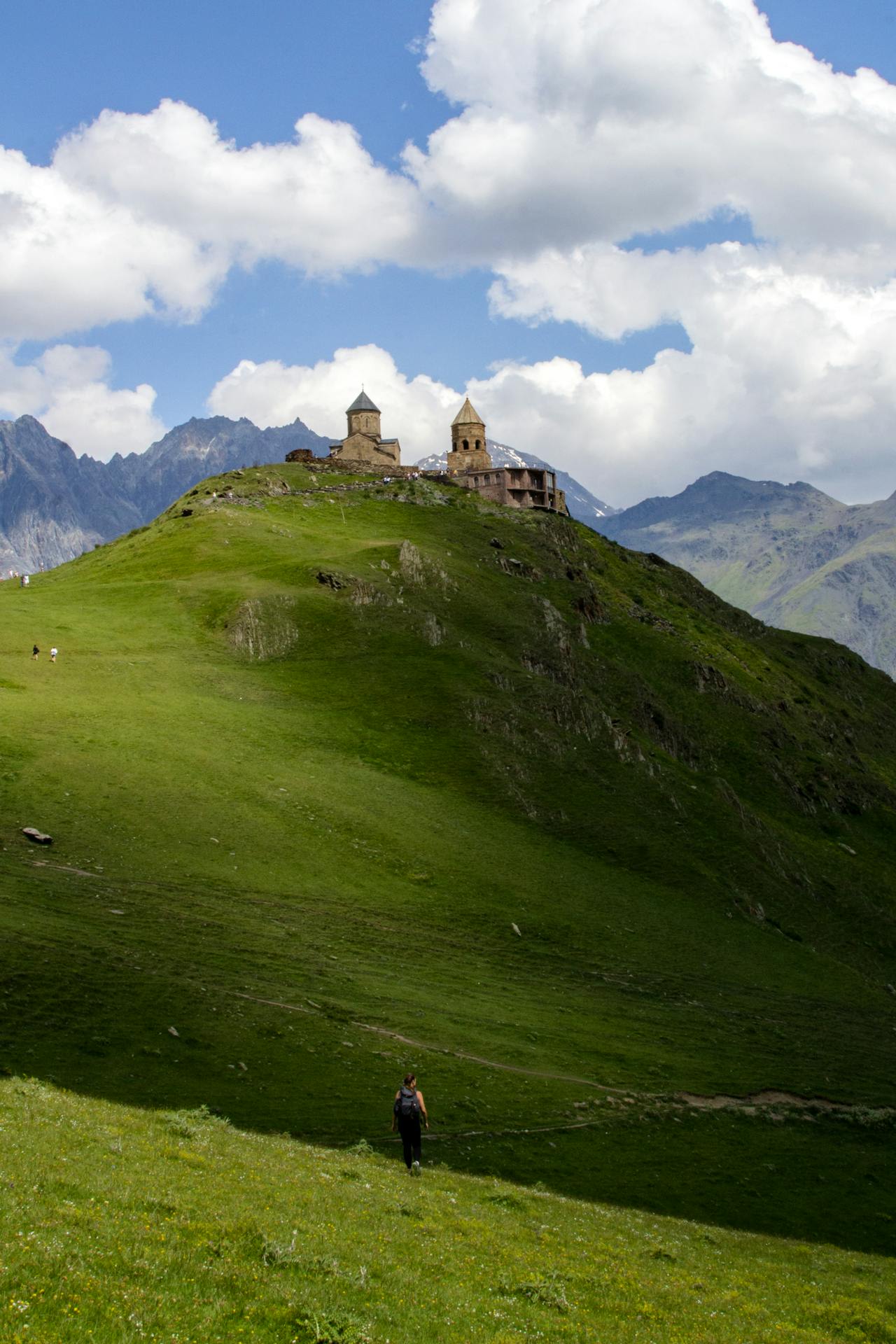
Kazbegi (officially renamed Stepantsminda in 2006, though universally known by its historical name) is a small mountain town of approximately 2,000 inhabitants in the Greater Caucasus of northern Georgia, at 1,740 metres altitude in the Terek river valley near the Russian border. It is the site of one of the most photographed juxtapositions in the world: the 14th-century Gergeti Trinity Church (Tsminda Sameba) — a medieval Georgian Orthodox church of austere stone construction — sitting on an isolated cliff at 2,170 metres directly beneath the glaciated volcanic cone of Mount Kazbek (Georgian: Mqinvartsveri, 'ice-topped mountain'), which rises to 5,047 metres and carries six major glaciers on its upper flanks. The combination of human architecture and natural mountain at this scale and proximity creates an image of surpassing drama that represents Georgian mountain culture at its most concentrated. The area is protected within Kazbegi National Park (8,699 km²) and forms part of the Greater Caucasus wilderness that spans the Georgia–Russia border.
🌍 Geography and Ecosystem
- Gergeti Trinity Church (Tsminda Sameba): A 14th-century Georgian Orthodox church and separate bell tower on a 2,170-metre spur above Stepantsminda, reached by a 2.5-hour hike from the town or by 4WD track. The church is still in active religious use — monks reside here year-round — and visitors are expected to dress modestly and behave respectfully. The view of Kazbek from the church terrace is one of the defining images of the Caucasus.
- Daryal Gorge: A 12-km gorge cut by the Terek river through vertical walls of dark metamorphic rock, through which the Georgian Military Highway (the primary land route between Georgia and Russia) winds beneath 400-metre cliff faces. The gorge was a strategic passage contested throughout Caucasian history and the site of several medieval fortress ruins on the cliff edges. Alexander Pushkin described the gorge in his 1836 travel essay A Journey to Arzrum.
- Truso Valley: A remote high-altitude valley east of Kazbegi, accessible by a 4WD track from the village of Kobi. The valley contains an extraordinary landscape of travertine mineral springs — orange, blue-green, and white carbonate formations surrounding bubbling sulphurous pools — alongside ruins of abandoned medieval villages and the imposing Zakagori fortress ruins. The travertine formations are among the finest in the Caucasus.
- Gveleti Waterfalls: Twin waterfalls on the Gveleti river, a Terek tributary near the southern end of the Daryal Gorge, reaching approximately 30 metres. The falls are accessible by a 2-km path from the highway and are surrounded by mixed Caucasian forest including Georgian oak, hornbeam, and the distinctive Caucasian rhododendron (Rhododendron caucasicum), which colours the subalpine zone yellow-white in June.
📜 History and Cultural Significance
The Georgian Military Highway (Gruzinskoye Voennoye Shosse), built by the Russian Empire between 1799 and 1817 to connect Tiflis (Tbilisi) to Vladikavkaz across the Caucasus Mountains, transformed the Kazbegi valley from an isolated highland community to a strategic military and commercial artery. The highway construction required enormous engineering effort in the Daryal Gorge section and was the subject of Romantic literary celebration by Alexander Pushkin, Mikhail Lermontov, and Alexandre Dumas père, who all passed through the gorge on famous journeys to the Caucasus in the early 19th century and produced accounts that introduced the landscape to European literary audiences.
🏃 Activities and Attractions
- Gergeti Trinity Church Hike: The 2.5-hour ascent from Stepantsminda town to the church at 2,170 metres is the essential Kazbegi experience — one of the finest short mountain hikes in the Caucasus, ascending through subalpine meadow and rhododendron scrub to the church terrace with Kazbek dominating the view to the north. The return offers completely different perspectives. Start early to beat afternoon cloud over the summit. 4WD vehicles can also be hired in town for those unable to hike.
- Mount Kazbek Ascent (Mountaineering): Kazbek is one of the classic Caucasian peaks — a technically moderate but physically demanding 2-3 day ascent via the Gergeti Glacier, requiring full mountaineering equipment (crampons, ice axe, rope) and experience. The normal route acclimatisation camp is at the Bethlemi Hut (3,653 m), a Georgian Orthodox monastery refuge used since the 12th century. Guides are available through agencies in Stepantsminda and Tbilisi. The summit views encompass the entire Greater and Lesser Caucasus system.
- Truso Valley Trek: A full-day or overnight trek from Kobi village (accessible by mashrutka from Stepantsminda) into the Truso Valley, visiting the travertine mineral springs, abandoned Zakagori fortress, and the ruins of medieval stone villages abandoned in the Soviet collectivisation period. The route returns through a gorge with iron ladders and crosses the Terek river headwaters.
- Juta Valley Hiking: The Juta Valley, accessible by 4WD or 4-hour hike from Stepantsminda, is a high glacial valley with a small shepherding village at 2,100 metres and superb views of the Chaukhi rock massif — a series of granite pinnacles resembling a miniature Dolomites. Day hikes to the Chaukhi lakes and pass (3,338 m) are among the finest in the Kazbegi area.
- Georgian Military Highway Scenic Drive: The 210-km road from Tbilisi to Stepantsminda passes through some of the most dramatic scenery in the Caucasus — the Cross Pass (2,379 m), the Gudauri ski resort plateau, the Ananuri fortress complex on the Zhinvali reservoir, and the Daryal Gorge. A guided half-day tour from Tbilisi to Stepantsminda and back makes the highlights accessible without overnight stay.
💡 Travel Tips
Best Season: June–September for all hiking routes and Gergeti church access. July–August are the peak months but the valley rarely feels crowded. October for autumn colours and quieter conditions. Winter (December–February) closes the Georgian Military Highway in heavy snow and limits access — arrive in 4WD only and check road conditions on the Georgian road authority website. Ski touring on the Kazbek glacier approach requires specialist winter mountaineering experience.
Accommodation: Stepantsminda has grown rapidly as a tourist destination with guesthouses ranging from basic homestays to boutique hotels with mountain views. The Rooms Hotel Kazbegi (glass-fronted, panoramic views) is the landmark luxury property. Book all accommodation at least 1 month in advance for July–August. Homestays with local families provide the most authentic experience.
Altitude and Acclimatisation: The valley floor at 1,740 m is unlikely to cause altitude sickness. The Gergeti church hike to 2,170 m may cause mild breathlessness. For Kazbek summit attempts, proper acclimatisation of 2+ days in the valley is mandatory. Bring sun protection — UV intensity at altitude is high year-round.
🌱 Conservation
The Devdoraki Glacier on the northeast flank of Kazbek has been the source of several catastrophic ice-rock avalanches in historical records, most recently in 1832 and 2014. The 2014 avalanche — triggered by a combination of ice fall, glacial moraine failure, and Terek valley channelling — created a debris dam that blocked the river for 12 hours and briefly threatened the Georgian Military Highway. Scientists at the Caucasus Mountain Research Institute in Tbilisi monitor glacier stability under climate change scenarios that project significant reduction of Kazbek's ice cover by 2100, with an increased probability of glacial instability events.
