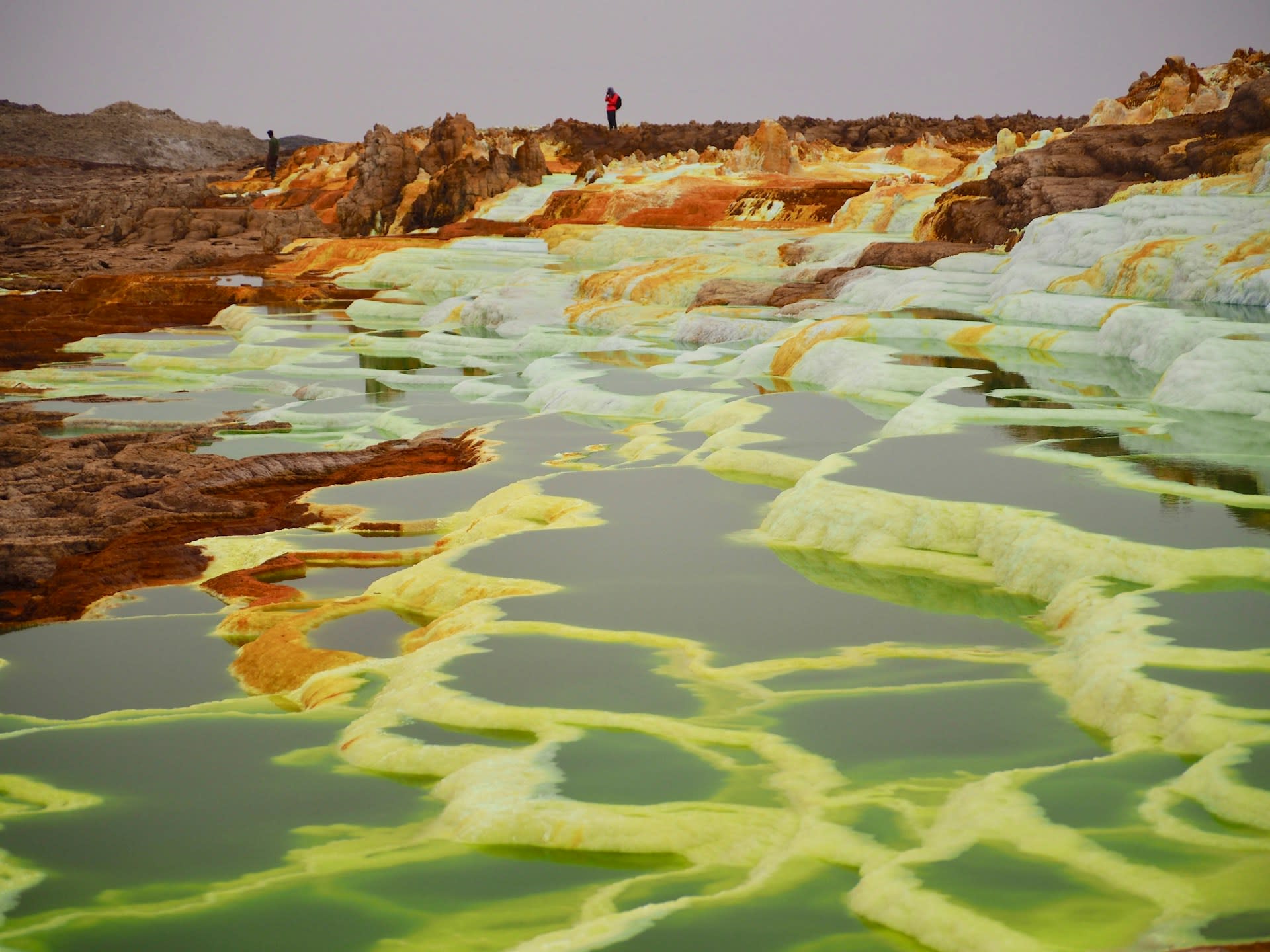
Danakil Depression
The Danakil Depression (also called the Afar Depression) is one of the most geologically active and climatically extreme places on Earth — a tectonic depression in the Afar Triangle of northeastern Ethiopia where three tectonic plates (the African, Arabian, and Somali plates) are actively pulling apart at one of the fastest spreading rates on the planet. The depression reaches a maximum depth of −116 metres below sea level, making it one of the lowest points on Earth's surface, and records mean annual temperatures of 34–35°C with daytime maximums regularly exceeding 50°C — consistently cited as the hottest inhabited place on Earth. The landscape is defined by three extraordinary geological features: the Erta Ale shield volcano, whose summit crater contains one of the world's few permanent lava lakes; the Dallol hydrothermal field, whose sulphur springs, acid pools, and salt towers create a landscape of alien colour found nowhere else on Earth; and the vast Karum salt flats, mined by the Afar people using camel caravans in a practice essentially unchanged for 1,000 years.
🌍 Geography and Ecosystem
- Erta Ale Lava Lake: One of only approximately 5 permanent lava lakes on Earth (others in DR Congo, Vanuatu, and Antarctica), the Erta Ale crater contains a churning, convecting pool of basaltic lava at approximately 1,100°C, approximately 100 metres below the crater rim. The crater is approached by a 3-hour night hike from the base camp to avoid the most dangerous daytime temperatures. The sight and sound of active lava — cracking, bubbling, spitting incandescent spray — at close range is one of the most extraordinary natural experiences on Earth.
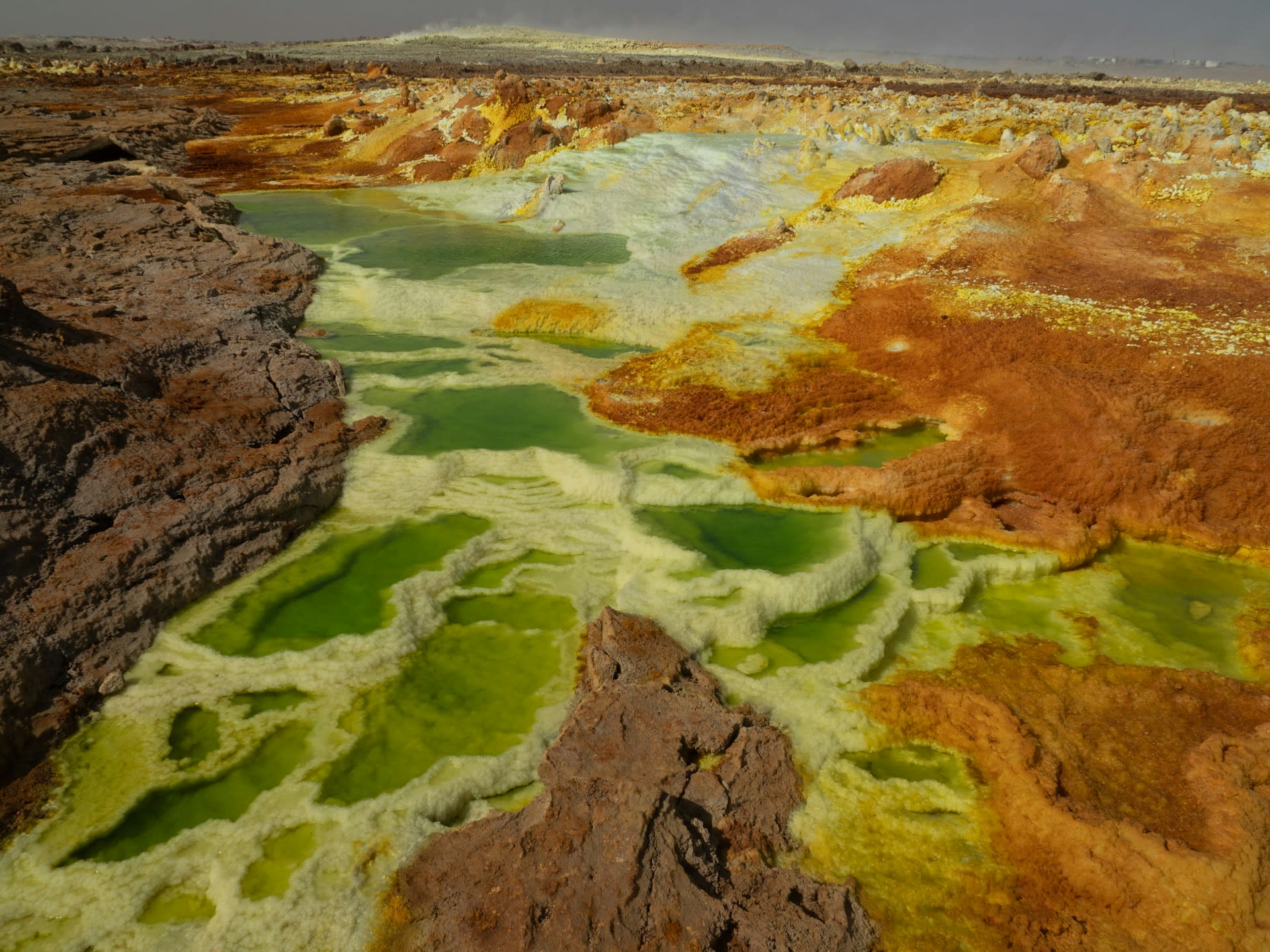
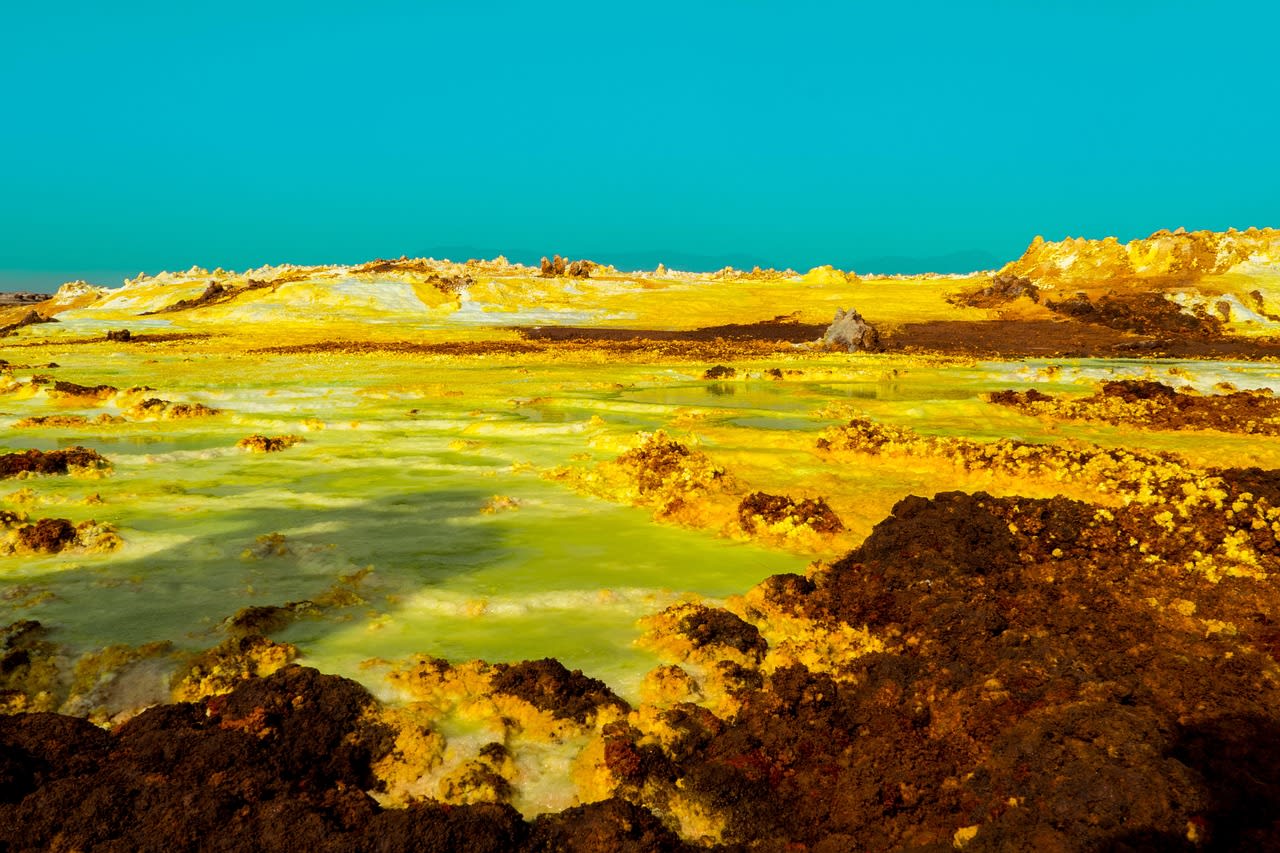
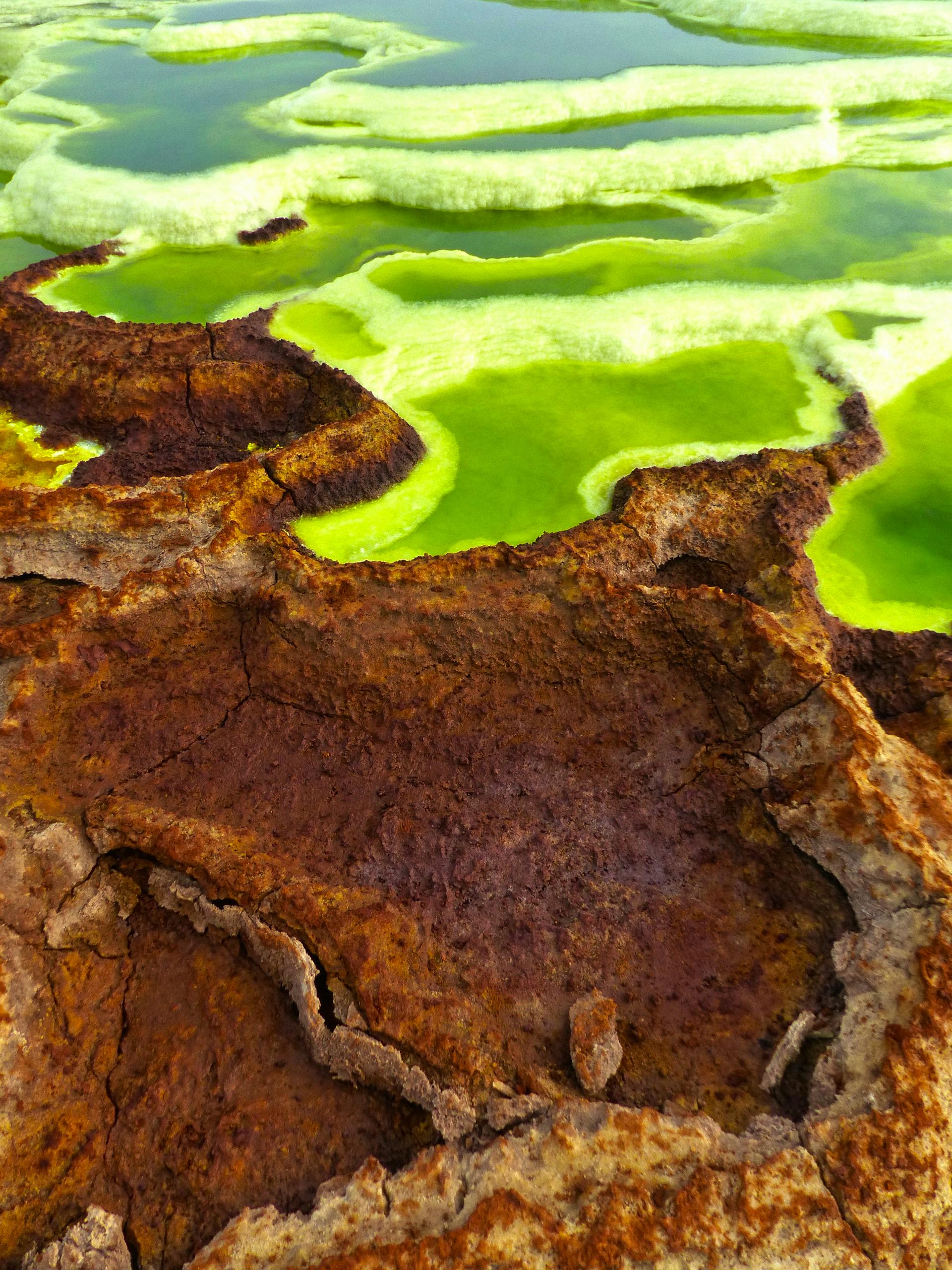
- Dallol Hydrothermal Field: A salt dome approximately 60 metres above the surrounding lake bed surface, saturated with hot, hyperacid, hypersaline hydrothermal fluid that erupts through the surface as springs, pools, and geysers of brilliant yellow (sulphur), orange (iron compounds), green (brine algae), and white (salt). The temperature of the springs reaches 112°C, and the pH is as low as −0.2 — effectively battery acid. The colours are among the most vivid and alien in nature. The site is also significant as a location where scientists study extremophile organisms as analogues for potential life on other planets.
- Lake Asale (Karum) Salt Flats: A vast evaporite lake on the depression floor, covered by a crust of halite (rock salt) up to 5 metres thick. The salt is mined by the Afar people using traditional methods — camel trains carry salt blocks cut by hand from the lake surface on a 3-day round journey to the highland markets at Mekelle, a trade that has been continuous for over 1,000 years. The sight of camel caravans loading salt blocks at dawn on the luminescent white salt flat against the volcanic mountains behind is one of Africa's most powerful visual experiences.
- Yellow Lake (Gale Ale): A small hypersaline, hyperacid lake on the Dallol mound with water of an intense yellow-green colour from dissolved sulphur compounds and iron chloride. The lake surface has a temperature of approximately 60°C and a pH of approximately 0.5. It is considered uninhabitable by any known cellular organism — recent studies controversially claiming bacterial life in similar Dallol pools were subsequently disputed.
📜 History and Cultural Significance
The Danakil Depression gained global scientific significance in 1974 when palaeoanthropologist Donald Johanson and his team discovered the nearly complete skeleton of a hominin female in the Hadar formation of the Afar region — designated AL 288-1 and nicknamed Lucy, she was identified as Australopithecus afarensis and dated to 3.2 million years ago. At the time of discovery, Lucy was the oldest and most complete hominin skeleton known, and her species is now understood as one of the likely ancestors of the genus Homo. The Afar Depression has subsequently yielded a rich fossil record of human evolution spanning over 5 million years, making it one of the most important palaeoanthropological regions in the world — the literal cradle of humanity.
🏃 Activities and Attractions
- Erta Ale Volcano Overnight Trek: The signature Danakil experience — a 3-hour night ascent of Erta Ale's flanks from the base camp at Dodom, arriving at the crater rim at approximately midnight to view the lava lake by night. The red glow is visible from 5 km away. The return hike takes place in pre-dawn darkness before the temperature becomes life-threatening. Physical fitness is essential — the hike is at altitude (613 m) in residual heat even at night. Tours include a full camping night at the crater rim.
- Dallol Hydrothermal Visit: Tours to the Dallol field require 4WD vehicles that cross the Karum salt lake surface (the only route) and arrive at the mound for the early morning visit before temperatures peak. Walking among the acid springs and sulphur formations is unrestricted on designated paths but requires care — the crusted salt surface overlies the springs and can give way, and the acid fumes are irritating at ground level. The photographic opportunity here — the most colourful natural landscape in Africa — is exceptional.
- Afar Salt Caravan Observation: The daily activity of Afar salt miners on the Karum lake surface — cutting rectangular halite blocks with traditional iron bars, loading them onto camel backs, and departing in a long caravan toward the highland — is one of the living cultural traditions that give the Danakil its human dimension. Tours that include time with the salt miners and their caravans provide context for the landscape that pure geology cannot supply.
- Hadar Fossil Site Visit: The palaeoanthropological site at Hadar in the Afar depression, where Lucy was discovered, is accessible on multi-day Danakil tours as an add-on. The national palaeoanthropology authority organises guided visits to the fossiliferous sediment outcrops where hominin bones have been found, with excellent interpretive context from specialist guides.
- Sulphur Springs and Lake Bakili: Several smaller hydrothermal features near Dallol — the Lake Bakili salt pan with orange brine pools, and the Gaet'ale hypersal lake (the saltiest natural body of water on Earth, with a salinity of 43%) — extend the geological diversity of a Dallol day tour.
💡 Travel Tips
Best Season: October–February for the most tolerable temperatures (35–40°C at Dallol instead of 50°C). The lava lake is most active and visually spectacular in the dry season. Avoid March–September when temperatures become genuinely life-threatening and several tour operators suspend operations.
Health and Safety: This is a genuinely dangerous environment. Carry at least 4 litres of water per person per day. Acclimatise in Mekelle for one day before descending into the depression. Protect skin against hydrothermal spray at Dallol (the acid is corrosive). The armed escort exists because of occasional security incidents — follow guide instructions exactly. Travel insurance with emergency evacuation cover is mandatory.
Recommended Operators: Ethio Travel and Tours, EthioTrek, and Greenland Tours are established Danakil operators with good safety records. Avoid the cheapest operators as safety corners are sometimes cut on food, water supply, and escort arrangements. 3-day tours (Erta Ale + Dallol) cost approximately USD 400–600 per person depending on group size.
🌱 Conservation
The Afar people face existential challenges from climate change — the combination of increasing temperature, decreasing rainfall, and more frequent drought events is reducing the pasture available for their herds and increasing the frequency of conflict over water resources. The salt trade, which provides the primary cash income for the deepest Afar communities, is under commercial pressure from industrial salt extraction from the Karum deposits by Eritrean and Ethiopian companies — a development that could undermine the traditional economy that has sustained the community for 1,000 years. The palaeoanthropological heritage of the Afar Depression is protected under the Ethiopian Cultural Heritage Proclamation, with all hominin fossil sites registered and access controlled by the Authority for Research and Conservation of Cultural Heritage (ARCCH).