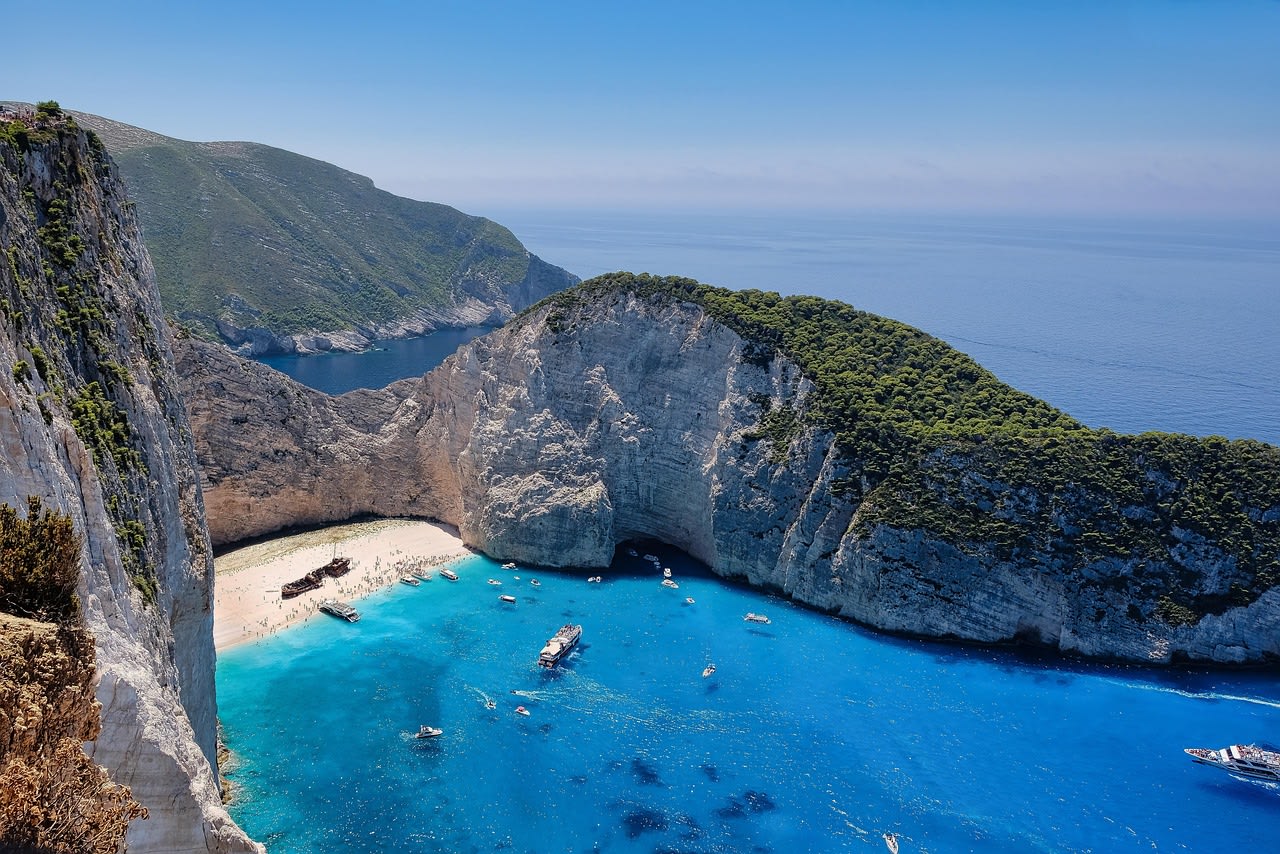
Navagio Beach
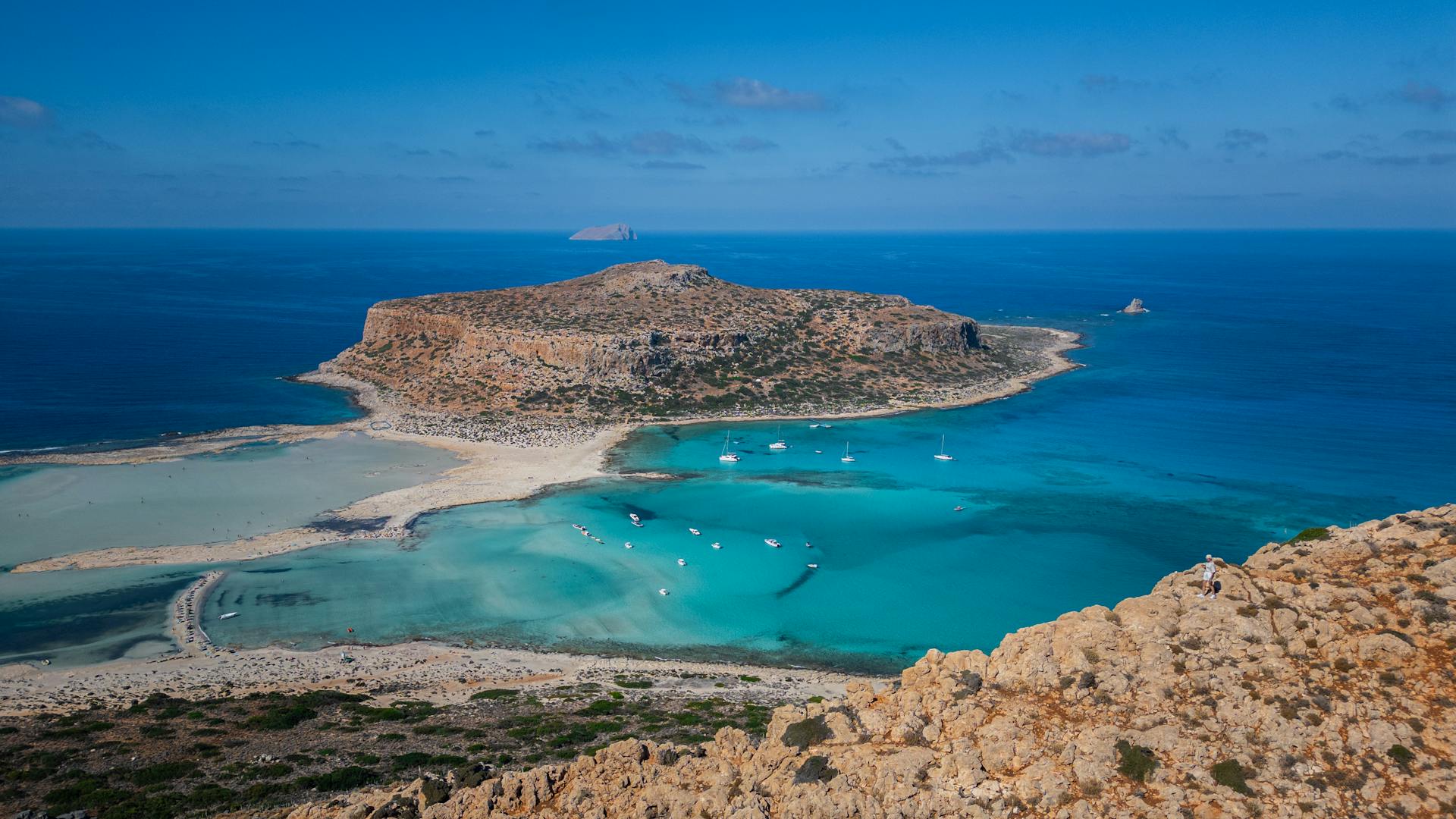
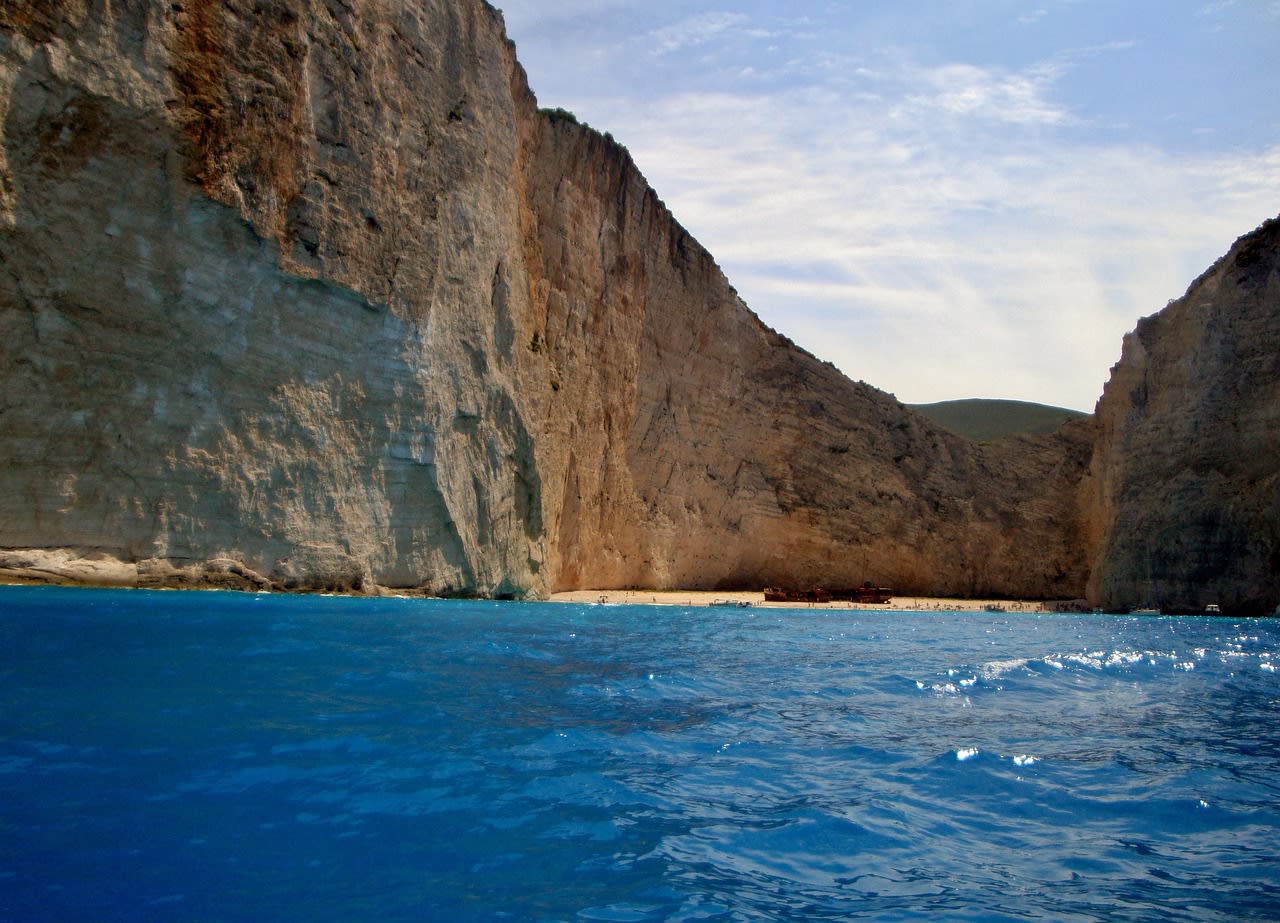
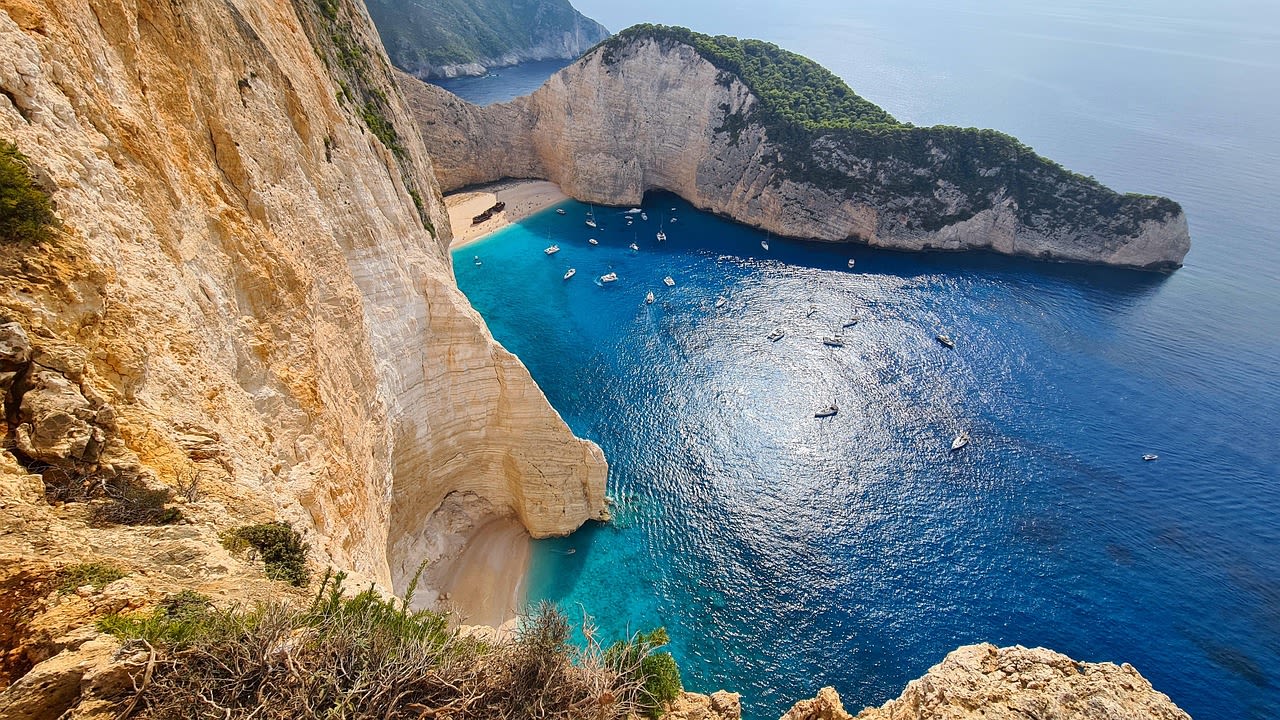
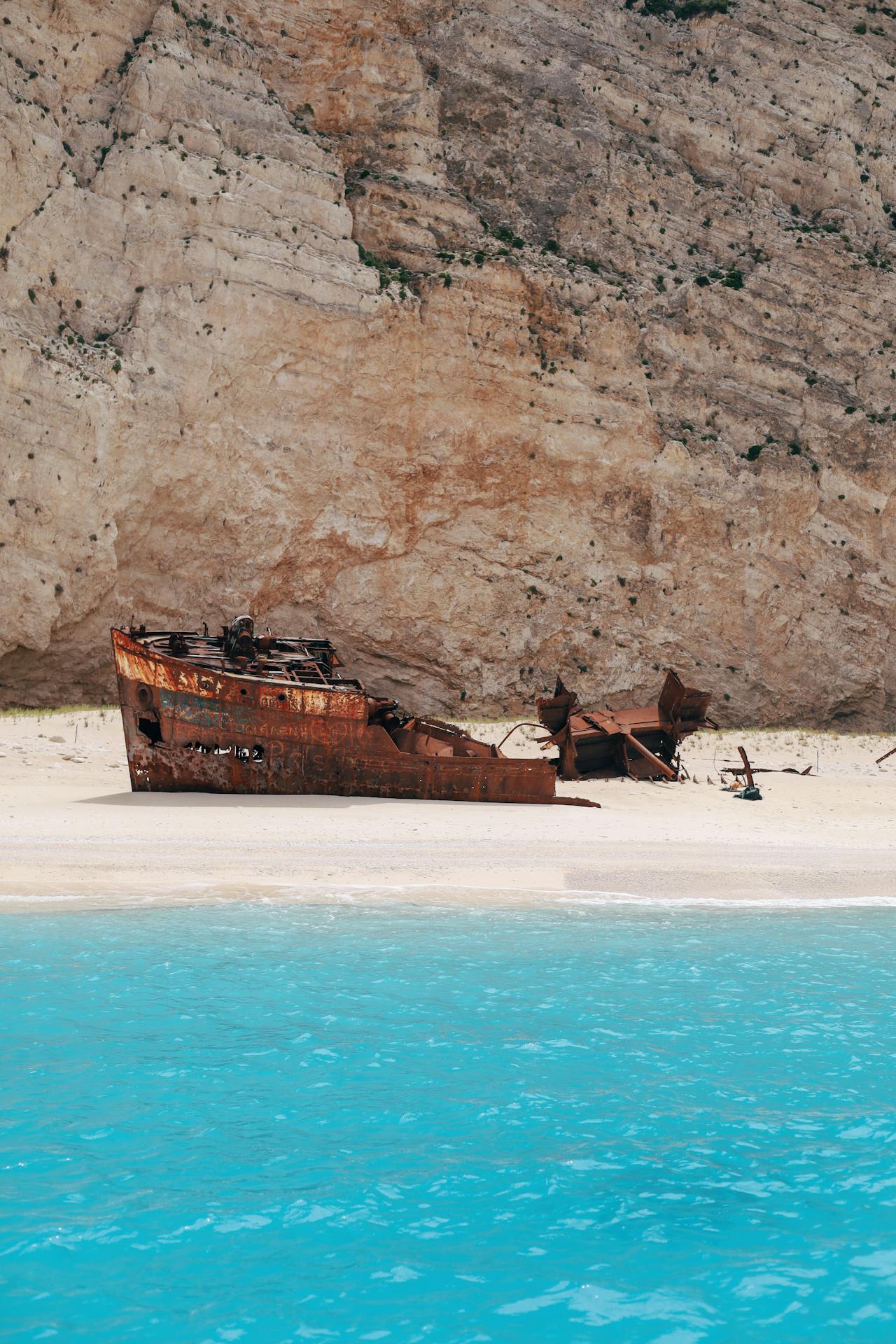
Navagio Beach — officially called Agios Georgios but known universally as Shipwreck Beach — is a small cove on the northwest coast of Zakynthos (Zante) island in the Ionian Sea, enclosed on three sides by vertical white limestone cliffs of 100–200 m and open to the sea only through a narrow channel too shallow and wave-swept for most vessels. The beach itself is a short arc of brilliant white pebbles and sand of extraordinary brightness — the white limestone geology dissolving into sediment of near-photographic whiteness — against water of an impossible turquoise blue produced by the shallow white limestone seabed and the clarity of the Ionian Sea. At the centre of the beach sits the rusting hulk of the MV Panagiotis — a freighter that ran aground in this cove in 1980, allegedly while carrying contraband smuggled goods — that has become the defining element of one of the most widely reproduced beach photographs in the world. The beach is accessible only by boat from the port of Porto Vromi (4 km) — no road reaches the cove, and the clifftop above is accessible on a short trail for the aerial view. Navagio has been consistently ranked among the world's most beautiful and most photographed beaches.
🌍 Geography and Ecosystem
- Limestone Cliff System: The cliffs enclosing Navagio Beach are part of a continuous cliff system running along the northwest Zakynthos coast — the most dramatic coastal geology in the Ionian islands. The limestone is Cretaceous and Eocene in age, uplifted and tilted by Alpine compression, and eroded by wave action and winter swell into a series of enclosed coves, sea caves, and natural arches of which Navagio is the most visually spectacular. The colour of the cliff — near-white with grey and ochre streaks where iron-bearing minerals are present — is responsible for the extraordinary seawater colour, which reflects the white limestone bottom in shallow water up to 15 m depth.
- Sea Caves of Cape Skinari: The northwest Zakynthos coast north of Navagio contains one of the finest sea cave systems in Greece — the Blue Caves at Cape Skinari, accessible only by small boat, where the sun angle at certain times of day illuminates the cave floor and walls with refracted light of extraordinary blue intensity. The cave system extends for several hundred metres and includes chambers accessible by small boat, snorkelling passages, and open-top caverns where the limestone ceiling has collapsed. Blue Caves visits are typically combined with Navagio excursions on half-day boat tours from Zakynthos town.
- Caretta Caretta Nesting Beaches: Zakynthos is one of the most important nesting sites in the Mediterranean for the loggerhead sea turtle (Caretta caretta) — the Laganas Bay on the island's southern coast hosts the largest loggerhead nesting concentration in the Mediterranean (approximately 1,000 nests per year). The National Marine Park of Zakynthos (established 1999) protects these nesting beaches with strict access restrictions during the June–October nesting and hatching season. Sea turtles are commonly seen snorkelling around the island, and boat tours from Navagio heading south often encounter turtles feeding in the open Ionian water.
- Ionian Water Quality: The Ionian Sea around Zakynthos is among the clearest and least polluted sea water in Greece — the island's position away from major industrial centres and river systems, and the Ionian current bringing Atlantic water from the Strait of Gibraltar, maintains exceptional water quality. Visibility in the open sea is 20–30 m; in the enclosed coves like Navagio, where wave action keeps sediment suspended, it is 10–15 m, sufficient to see the bottom of the entire cove from the surface.
📜 History and Cultural Significance
The beach entered global consciousness through the expansion of travel photography in the 1990s–2000s — its combination of white cliff, turquoise water, white beach, and rust-red wreck in a single enclosed frame is the ideal travel photograph composition, scalable from postcard to poster without loss of impact. The explosion of social media photography from 2010 onwards made Navagio the single most Instagram-tagged beach in Europe, generating the boat traffic and visitor numbers that now represent the site's primary management challenge.
🏃 Activities and Attractions
- Boat Visit to the Beach: Scheduled boat excursions from Zakynthos town harbour and Porto Vromi (4 km from Navagio) operate daily from April to October, visiting Navagio with a 30–45 minute beach stop before continuing to the Blue Caves and returning. The approach through the narrow channel entrance — with the cliff walls rising 100 m above the boat on both sides and the wreck and white beach emerging from behind the cliff — is one of the most dramatic boat arrivals in the Mediterranean. Swimming from the boat or the beach during the stop is the main activity.
- Clifftop Viewpoint: A gravel road from the village of Anafonitria leads to a clifftop platform 200 m above Navagio, with a metal viewing barrier at the cliff edge providing the aerial view that is the most reproduced Navagio image — the turquoise horseshoe of water, the white beach, and the rusting wreck, all contained in the cliff frame. The viewpoint is free and accessible by car or scooter, and delivers the full visual impact without the boat cost. Dawn and late afternoon light are optimal — midday sun flattens the colour contrast and the cliff casts deep shadows into the cove.
- Blue Caves Sea Kayaking: Sea kayaking from Cape Skinari into the Blue Caves system — paddling through sea cave entrances, under natural arches, and into illuminated chambers — is among the finest sea kayak experiences in the Ionian. Guided half-day tours depart from the Cape Skinari pier and access cave chambers too small for tour boats. The bioluminescence in certain cave chambers at night (August–September) is a separate guided nighttime kayaking experience offered by some operators.
- Scuba Diving: The northwest Zakynthos coast and the channel below Navagio Beach have excellent diving — the limestone reefs descend steeply from 5 m to 40+ m, with abundant sea life including octopus, moray eel, dentex, and grouper in the deeper zones. The wreck of the Panagiotis itself is diveable at low tide conditions — the hull sits in 5–10 m of water and the interior is accessible (with appropriate caution). Several dive operators in Zakynthos town operate daily boat dives to the northwest coast area.
💡 Travel Tips
Best Season: May–June and September–October are optimal — boat services operating, sea calm enough for reliable access, and visitor numbers below July–August peak. July–August is peak season — Navagio boats run frequently but the cove can have 10+ boats simultaneously and hundreds of swimmers. Note that winter swell (November–March) frequently makes Navagio inaccessible — the narrow channel is hazardous in waves above 1 m and boat services are cancelled on many winter days.
Turtle Awareness: Loggerhead turtle nesting beaches in the Laganas Bay area have strict access restrictions (June–October) — night visits to nesting beaches are prohibited without guide permits. However, casual encounters with turtles while snorkelling or on boat trips in the open sea are common and entirely permissible. The National Marine Park of Zakynthos (nmp-zak.gr) provides up-to-date information on access restrictions.
🌱 Conservation
The boat traffic problem — up to 100 boats per day visiting Navagio in peak summer — is managed by the Zakynthos Port Authority through limitations on the number of vessels permitted in the cove simultaneously and access windows of 30–45 minutes per boat. However, the restrictions are not always effectively enforced, and the combination of boat engine exhaust, anchor damage to the seabed, and visitor pressure on the beach (trampling the white pebbles, approaching the wreck structure) are causing measurable degradation. The National Marine Park of Zakynthos has proposed extending marine protection to the northwest coast to restrict heavy motor-vessel access — a measure strongly opposed by the tour boat industry.